24th April 2026
by Peter Coles
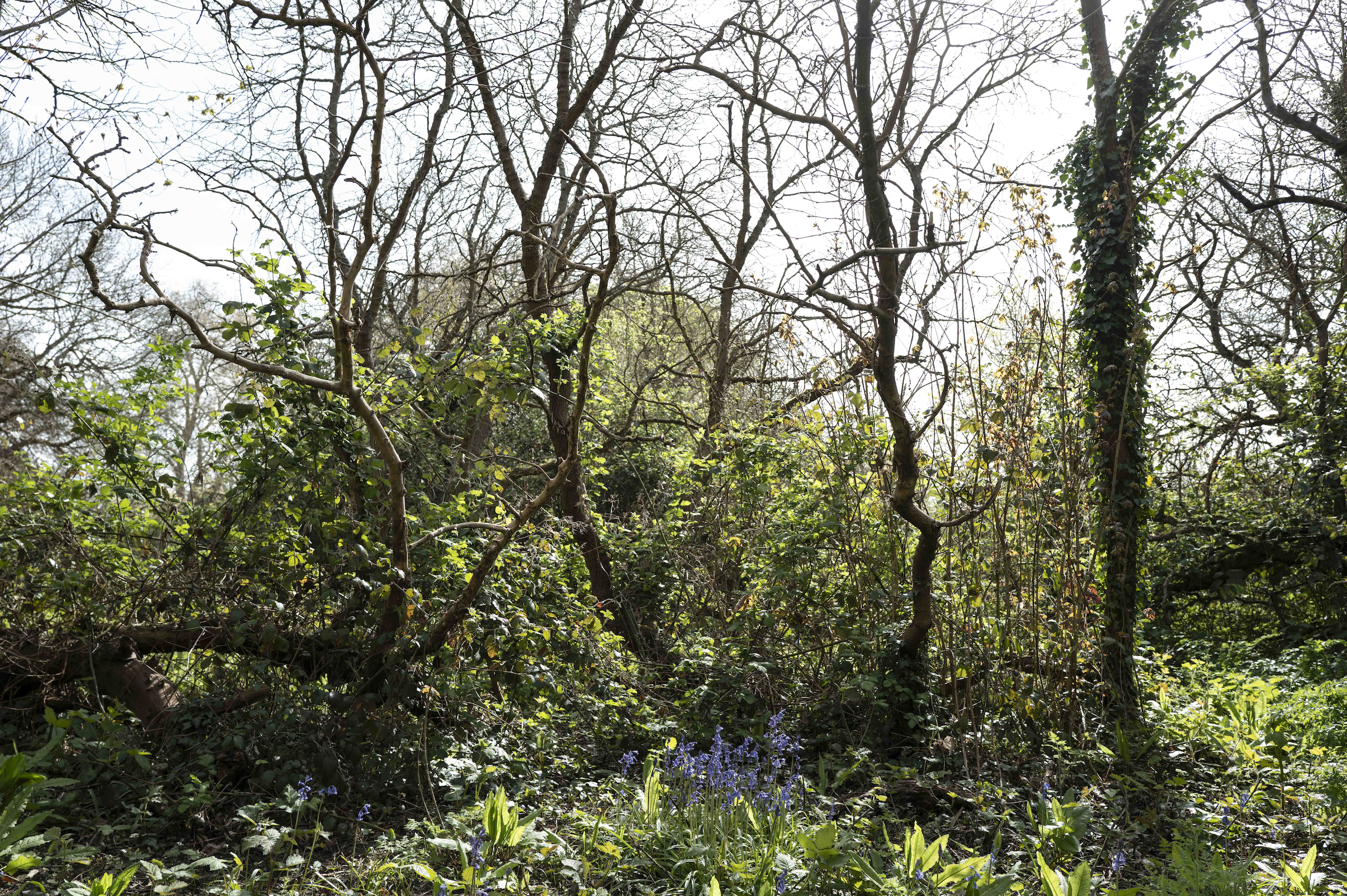
Bluebells under an ancient, layering mulberry tree (yes, a single tree) in the private orchard of Syon House
Morus Londinium’s 10th anniversary
Just before the UK’s mulberry trees wake up from their winter sleep, this is a perfect time to look back on the first quarter of 2026 and to share some of the latest news of our award-winning mulberry project, as it turns the corner of its first decade. We have come a long way since we started back in in May 2016, with a Heritage Lottery Fund grant, earning growing recognition as a resource both in Britain and, increasingly, abroad. Our map and data.base now boast over 1,230 recorded trees and are continually growing.Because so much has happened, this edition of the newsletter will be a long read!
In like a lion, out like a lamb…
There is an old adage that Spring has only arrived when you can put your foot on nine daisies at once (though the number varies between three and twelve). Well, that’s certainly the case now. And, in French, daisies are called “paquerettes”, from Pâques, (Easter), which falls on the first Sunday after the first full moon on or after the spring equinox. The daisy test is easier to remember.
The (paradoxically white) blackthorn blossom of March is now giving way to the blousy hawthorn of April, dissociated from its popular name of May, when it used to appear – everything’s a couple of weeks early this year. The new leaves, buds and flowers, known as ‘bread and cheese’, are starting to glow alongside last year’s drooping berries, now the colour of dried blood.
In the woodlands, nodding bluebells splash a haze of iridescent blue across the understory. Meanwhile, the more solitary black mulberry is still outstaring the encroaching spring without blinking, earning its Latin name Morus (‘delay’). As natural philosopher Pliny the Elder (AD 23-79) wrote almost 2,000 years ago, it is ‘the wisest of trees’ (sapientissima arbor), coming into leaf only when the threat of frosts has passed.
Milton’s mulberry movie

"Milton’s mulberry”, planted around 1609 in the Fellow’s Garden at Christ’s College, Cambridge (but not by Milton)
The New Year kicked off in early February with the premiere of a documentary film by Tony Eva about the celebrated and unique Milton’s Mulberry, growing in a mound in the Fellow’s garden at Christ’s College, Cambridge. I was one of the panellists answering questions about the tree, its history and the poet, Milton. A tender short film and a memorable evening that ended with dinner as guest of the Bursar of Christ’s.
Oatlands Park Hotel Mulberry
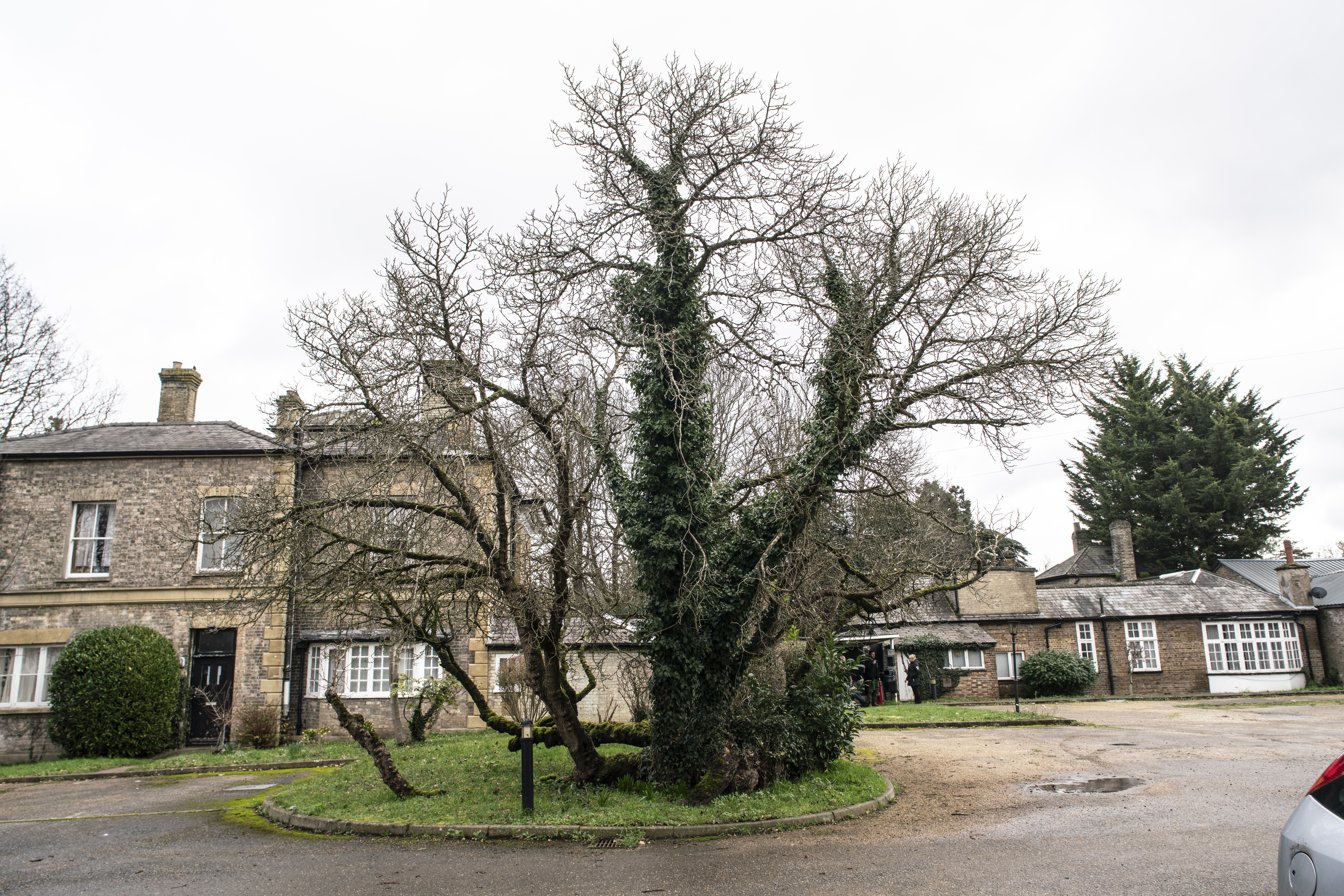
Black mulberry at Oatlands Park Hotel, Weybridge
The following week, consultant arboriculturist Richard Curtis invited me to join him at the Oatlands Park Hotel, in Weybridge (Surrey) as guests of the Manager, Nawaz Jamal. The magnificent Grade II listed 4-star hotel has an illustrious history stretching back to the 15th century. At the rear, isolated on a roundabout is a surprisingly tall, multi-stemmed black mulberry. It stands near to former stables, which are among the oldest parts of this site and probably dates to about 1856, when the hotel was remodelled. The hotel went on to receive several celebrity guests, including novelist Emile Zola and artist Edward Lear.
The multiple mulberry associations at the hotel date back to the Tudor and Jacobean Oatlands Palace, which was further down the hill in Weybridge and now persists only in the form of street names. In the early 17th century, King James I and his consort, Queen Anne of Denmark laid out a mulberry tree plantation here as part of their project to raise silkworms to spin silk. On the death of James I, the project was continued by his son, Charles I and his consort Henrietta Maria, the Rose and Lily Queen. There was even a silkworm house designed by celebrated architect Inigo Jones. The queen consort later appointed the royal gardener John Tradescant the Elder as Keeper of His Majesty’s Gardens, Vines and Read more here. After the execution of Charles I in January 1649 the palace was sold and demolished by the new owner.
The hotel's Mulberry Restaurant, overlooking a lake, celebrates both the veteran mulberry tree and the historic, disappeared plantation, while the grounds boast some fine, champion trees, including one of the UK’s oldest Cedars of Lebanon..
Historic reunion at Hatfield House’s 400-year-old James I mulberry tree.
It already seems an age since what turned out to be an historic meeting beside the ancient, hollow, leaning black mulberry tree in the West Garden of Hatfield House (on 27 February).
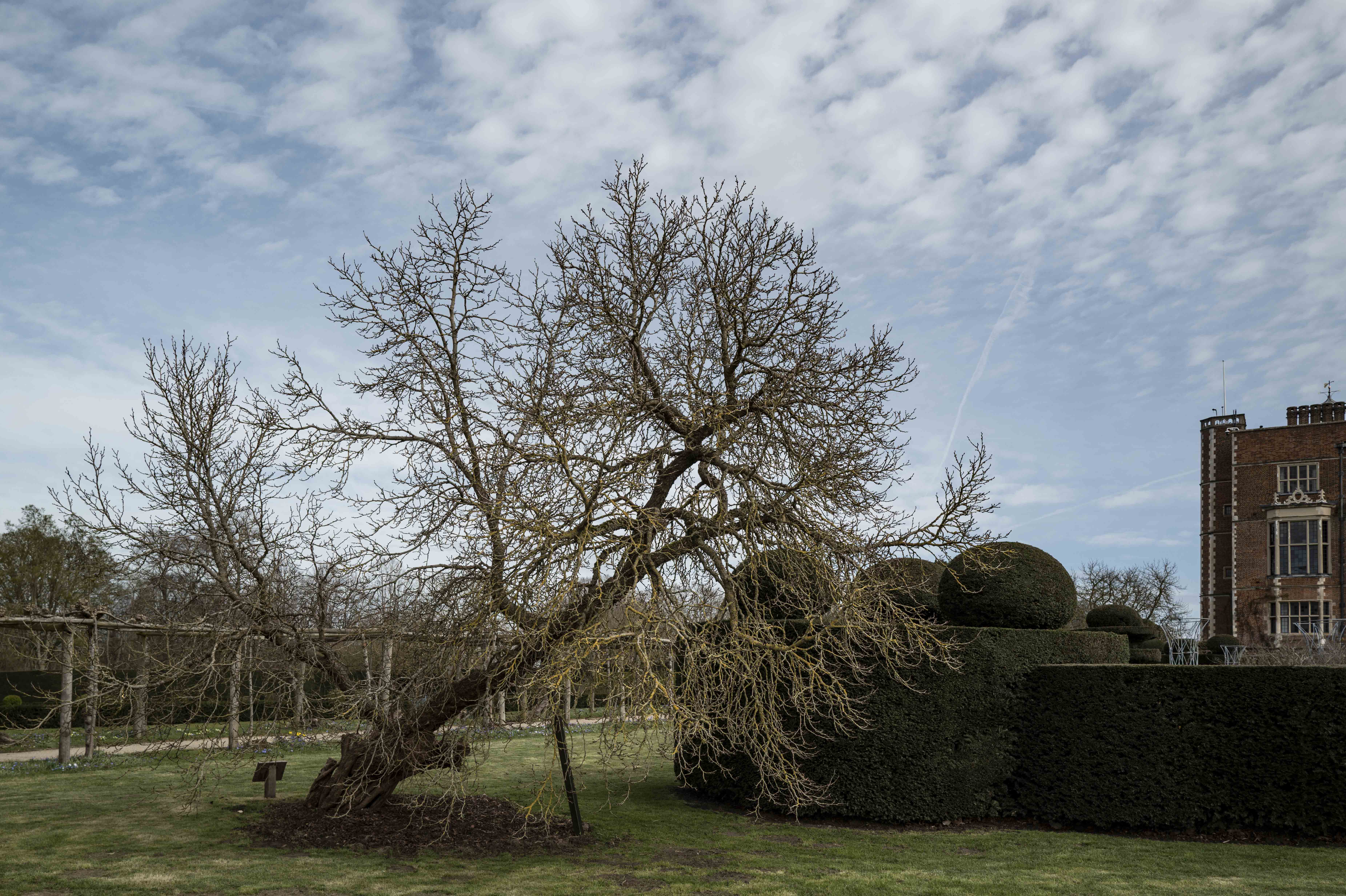
The ancient black mulberry in the West Garden probably dates to around 1611
A plaque claims the tree was planted in 1611 by King James I – on a visit to his then Secretary of State, Robert Cecil, first Earl of Salisbury, soon after building was completed of his new house. James had convinced Cecil to swap his father’s (Lord Burghley) magnificent Theobald’s estate at Cheshunt (Herts) – which James coveted – for the more modest Tudor Old Palace and other estates. It was here that Henry VIII’s youngest daughter, Princess Elizabeth – from his controversial marriage to Anne Boleyn – had spent much of her childhood and where she first heard she was to become queen.
Cecil demolished three wings of the Old Palace and built himself a modern house in the Jacobean style, one of the finest in the country. It is still owned (and lived in) by the Gascoyne-Cecil family (currently the 7th Marquess and Marchioness of Salisbury).
Robert Cecil employed a rising star of 17th century horticulture – and Britain’s first great gardener – John Tradescant the Elder (1570s-1638), to work alongside the celebrated landscape gardener Mountain (Muntun or Montague) Jennings, who laid out the gardens at Theobalds Palace. It was probably Tradescant who originally planted Hatfield’s surviving mulberry for the King’s visit – one of four black mulberries originally marking the corners of the newly laid-out West Garden. Hatfield House archives have bills from Tradescant’s trip to Leyden, Paris and Rouen in 1611-12, where he purchased ‘blak mulberry trees’ for his employer.
.jpg)
Taking cuttings from the mulberry [photo: © Sue Snell]
Left to right: Andrew Turvey, Head of Park and Gardens, Peter Coles, Adam Norris (Horticulturist), Matt Collins (Head Gardener at the Garden Museum), Amy Thompson (horticultural trainee), and Peter Oakenfull, arboriculture consultant.
It was to honour Tradescant’s role at Hatfield that Morus Londinium, with Garden Museum director, Christopher Woodward and Hatfield House’s Head of Park and Gardens, Andrew Turvey, put in motion a plan, hatched last winter, to take cuttings from the ancient Hatfield mulberry, eventually to be planted in grounds at the Garden Museum in South Lambeth, London, a plan fully endorsed by the Marquess and Marchioness.
The Garden Museum, housed in the deconsecrated church of St Mary-at-Lambeth, is the burial place of John Tradescant, his wife, and his son John, and contains many artefacts associated with his life and garden history. Tradescant’s famous house and nursery garden, The Ark, where he cultivated scores of exotic plants collected from overseas, once stood a short distance away in South Lambeth, now buried beneath streets of Victorian houses.
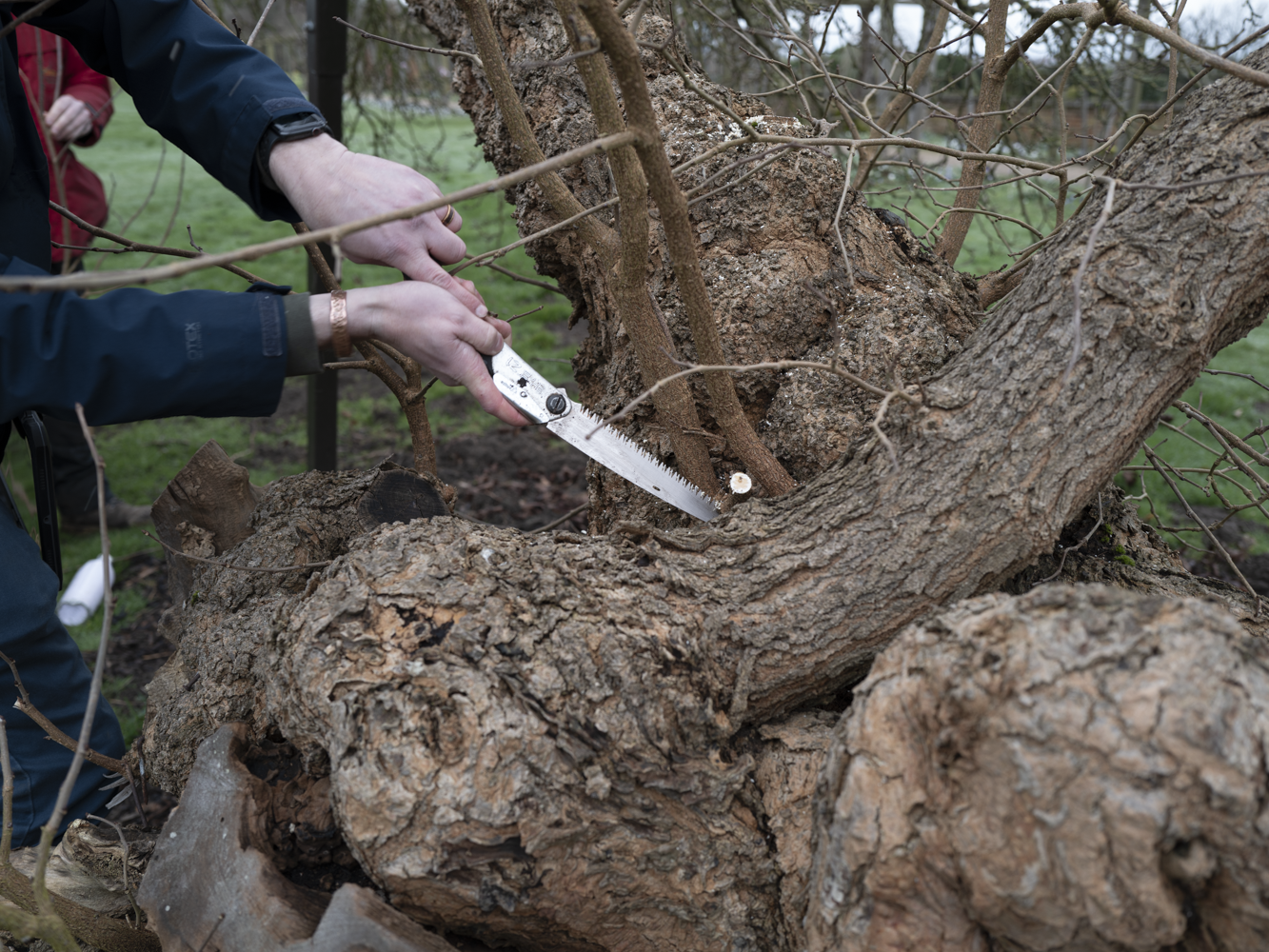
Andrew Turvey taking scion wood for propagation
So it was, at the end of February – during the mulberry’s dormant season – that Morus Londinium organised a historic meeting by the mulberry, hosted by Andrew Turvey, on behalf of the 7th Marchioness of Salisbury, who dropped by to say ‘hello’. Taking cuttings alongside Andrew and horticulturist Adam Norris, were Matt Collins, Head Gardener at the Garden Museum and horticultural trainee, Amy Thompson. Peter Oakenfull, valued consultant to the Hatfield Estate and a living archive of arboriculture experience, was also on hand.
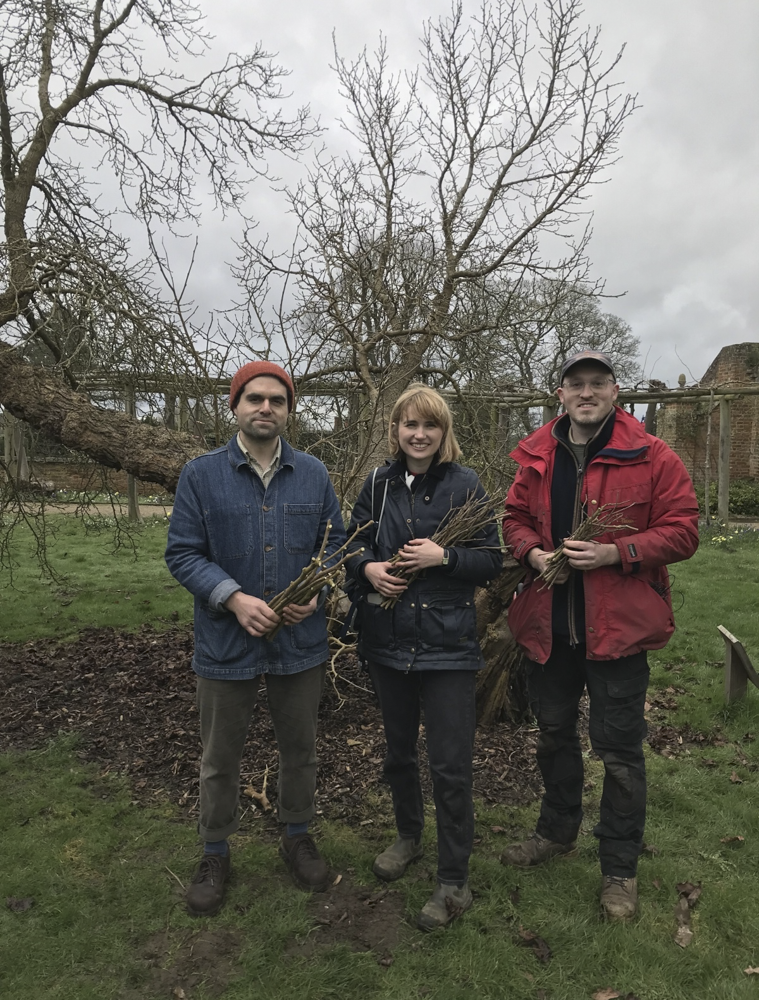
Matt, Amy and Adam with scion wood [Photo: Sue Snell]
A special guest that day was garden photographer, Sue Snell, who had photographed the gardens at Hatfield over 20 years ago for the Dowager 6th Marchioness, the celebrated garden designer, Majorie (“Mollie”) Salisbury, former president of the Garden Museum. This was Sue’s first visit to Hatfield House since the publication of her book, The Gardens of Hatfield in 2005. When the 6th Marquess died in 2003, the Dowager Marchioness left Hatfield to live at the family’s Dorset home, Cranborne Manor. So, this was quite an emotional event, topped by Sue’s unplanned meeting with the 7th Marchioness.
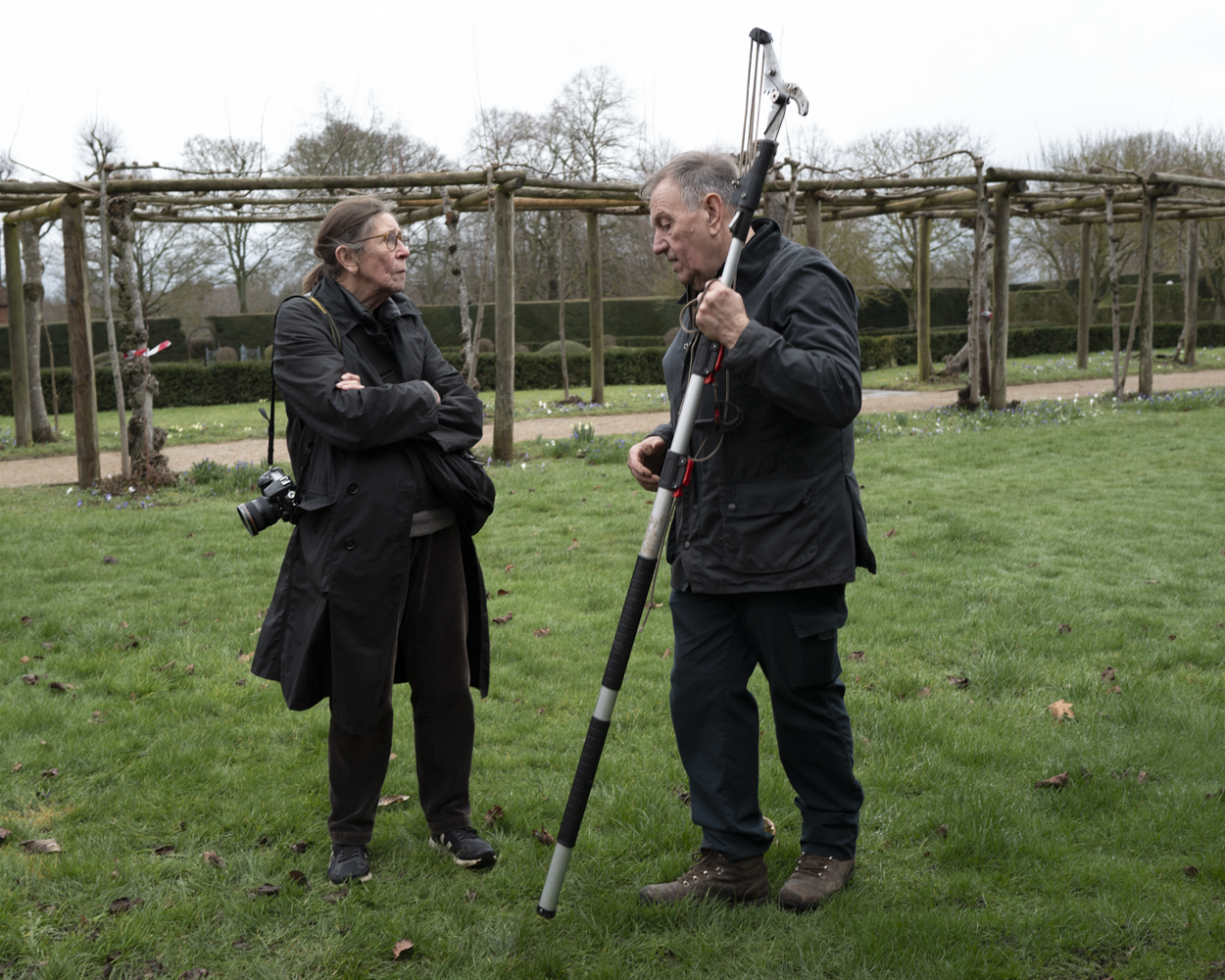
Photographer Sue Snell and Peter Oakenfell
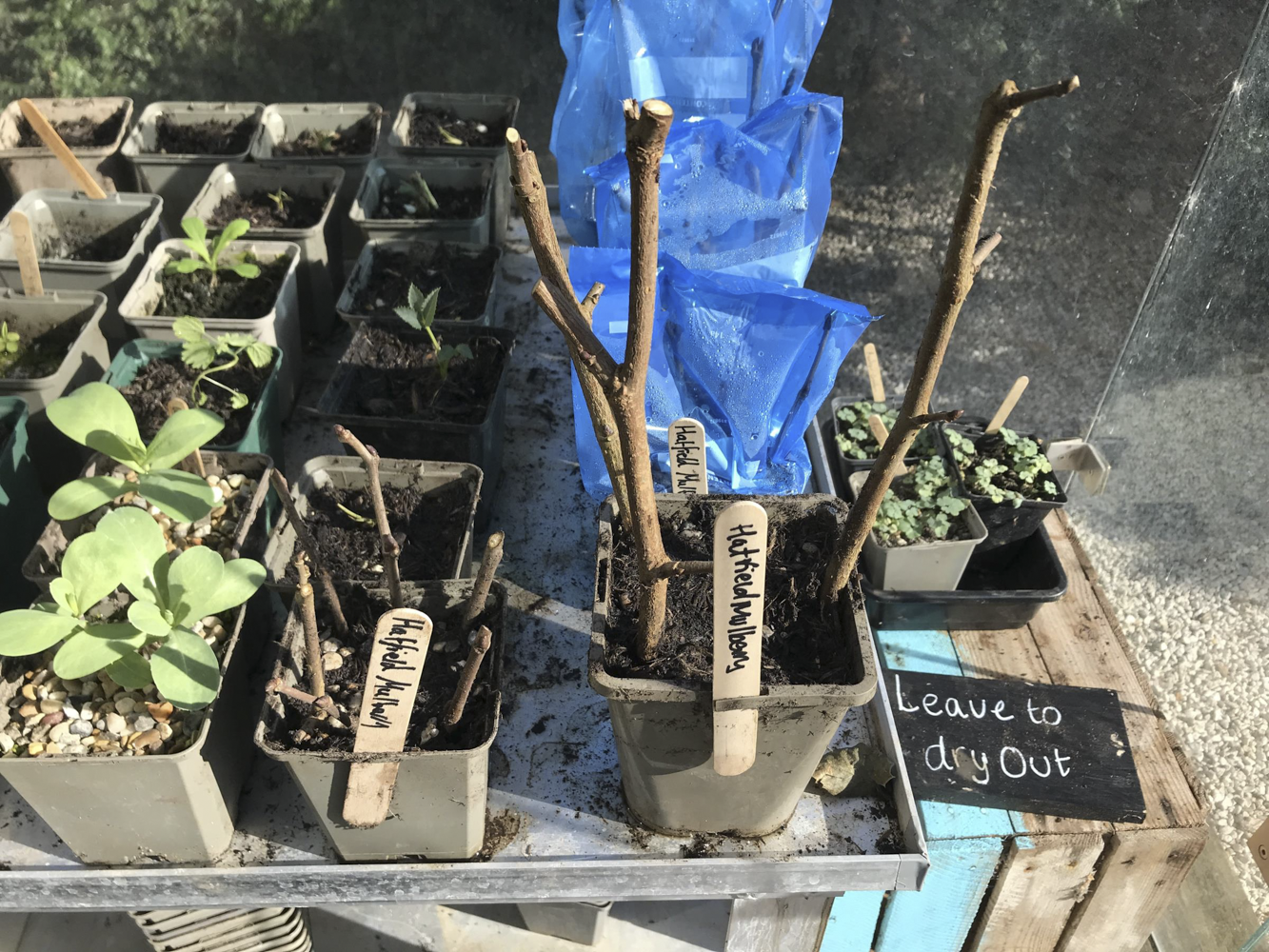
Cuttings safely potted up a few days later [Photo: Sue Snell]
We will be writing a full account of this adventure in a separate article, one of a planned series devoted to John Tradescant, father and son, and their legacy of mulberry trees.
Stamford’s historic mulberry
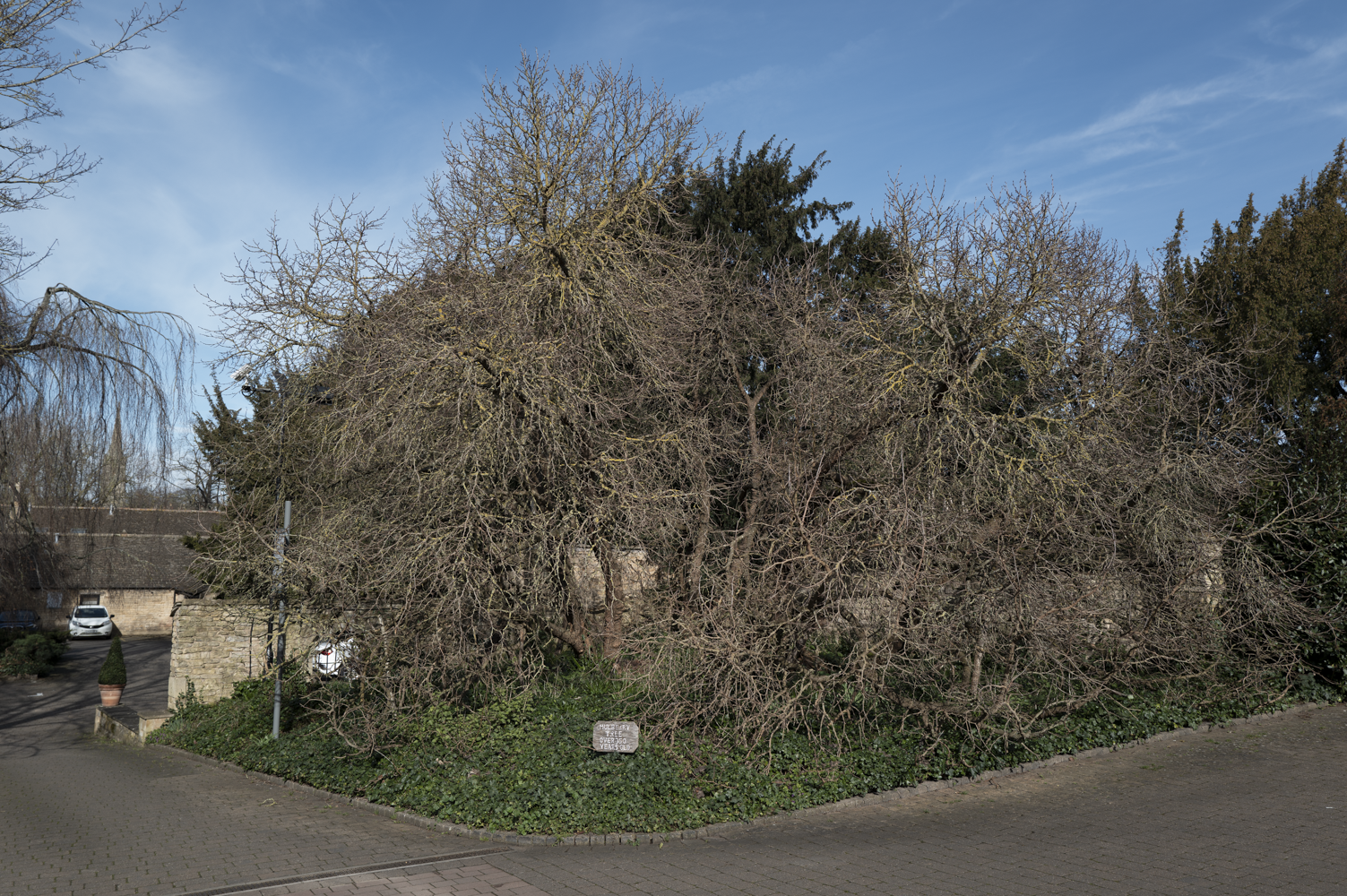
Sixty miles up the Great North Road, which defines the western and southern boundaries of Hatfield Park, is another historic black mulberry (also possibly 17th century), standing in the car park of The George Hotel, a former inn and staging post.
The hotel and gardens were once part of the Burghley Estate, on the site of a medieval “hospital” (place of shelter) for crusading Knights of the Order of St John. Burghley House (like Theobald’s) was built in the late 16th century by William Cecil, Lord High Treasurer to Elizabeth I. The estate passed, on his death, to his elder son, Thomas, 1st Earl of Exeter, half-brother to Robert, 1st Earl of Salisbury. Burghley House today belongs to a trust run by the 6th Marquess of Exeter and members of this branch of the Cecil family.
I spent a memorable day at The George with local nurseryman Adam Wade, who propagates mulberries and has extensive orchards just outside of Stamford. We were both guests of the current owner of The George, Andrea Hoskins
Chelsea Hospital’s venerable mulberry
Photographer friend, Sue Snell (who came for our historic visit to Hatfield), has been urging me for over a year to contact Ric Glenn, Grounds Manager at the magnificent Royal Hospital, Chelsea (home of the iconic Chelsea Pensioners - and the annual Chelsea Flower Show) and to arrange to see the fine black mulberry on the terrace at the top of the lawn, on the Thames side of the grounds. A year ago, she took a photo of the tree and forwarded it to me to prompt me to visit. Just as well, as it happens.
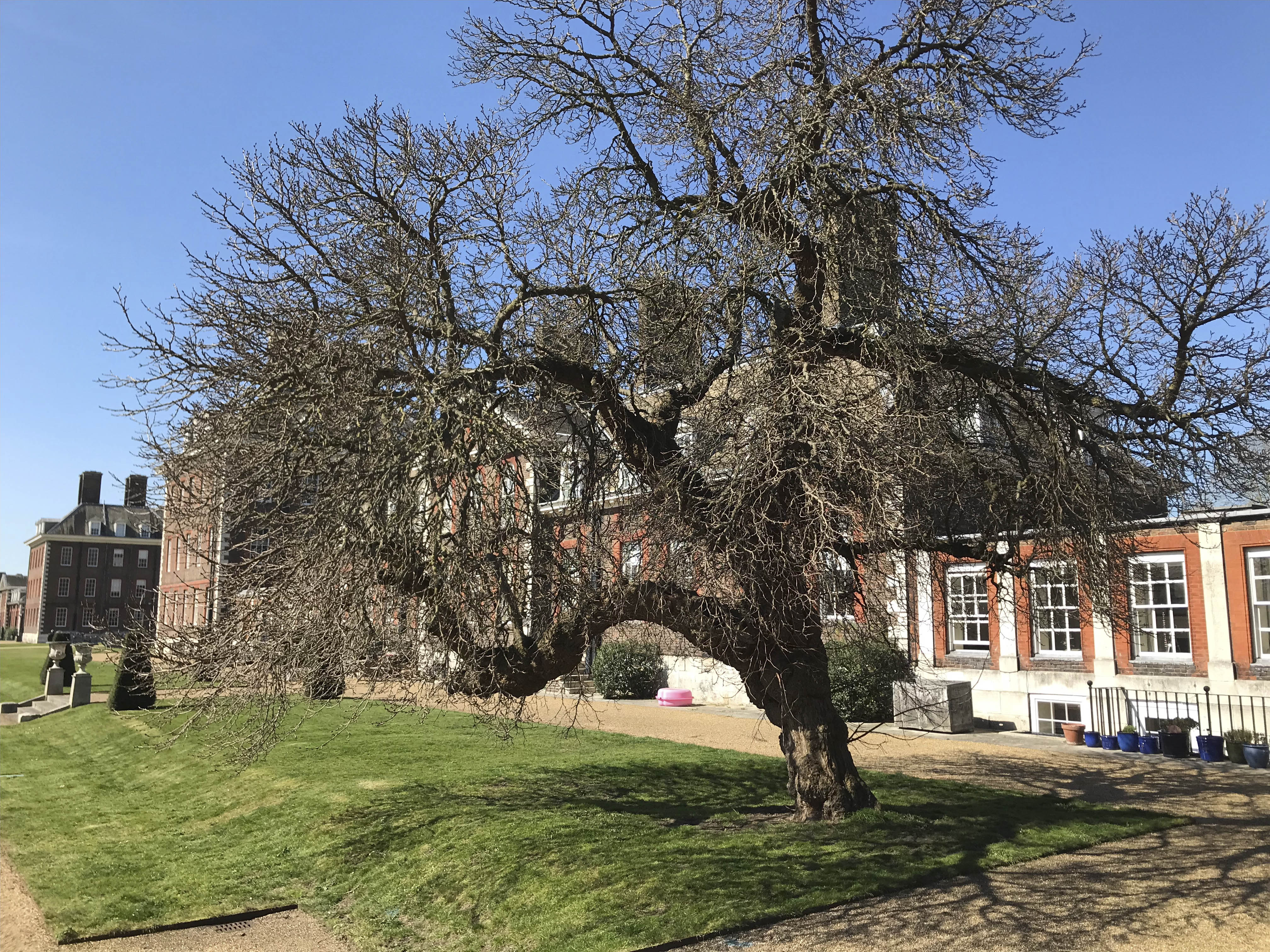
Black mulberry on the terrace on 2 April 2025 [Photo: Sue Snell]
When I finally got to meet Ric in March this year – a warm and welcoming Australian who is mad about mulberries – the tree had done the splits and now has a massive branch arching gracefully to the ground. Ric and his team (aided by an enthusiastic pensioner) have propped the swooping branch and are keeping an eye on it. So far so good.
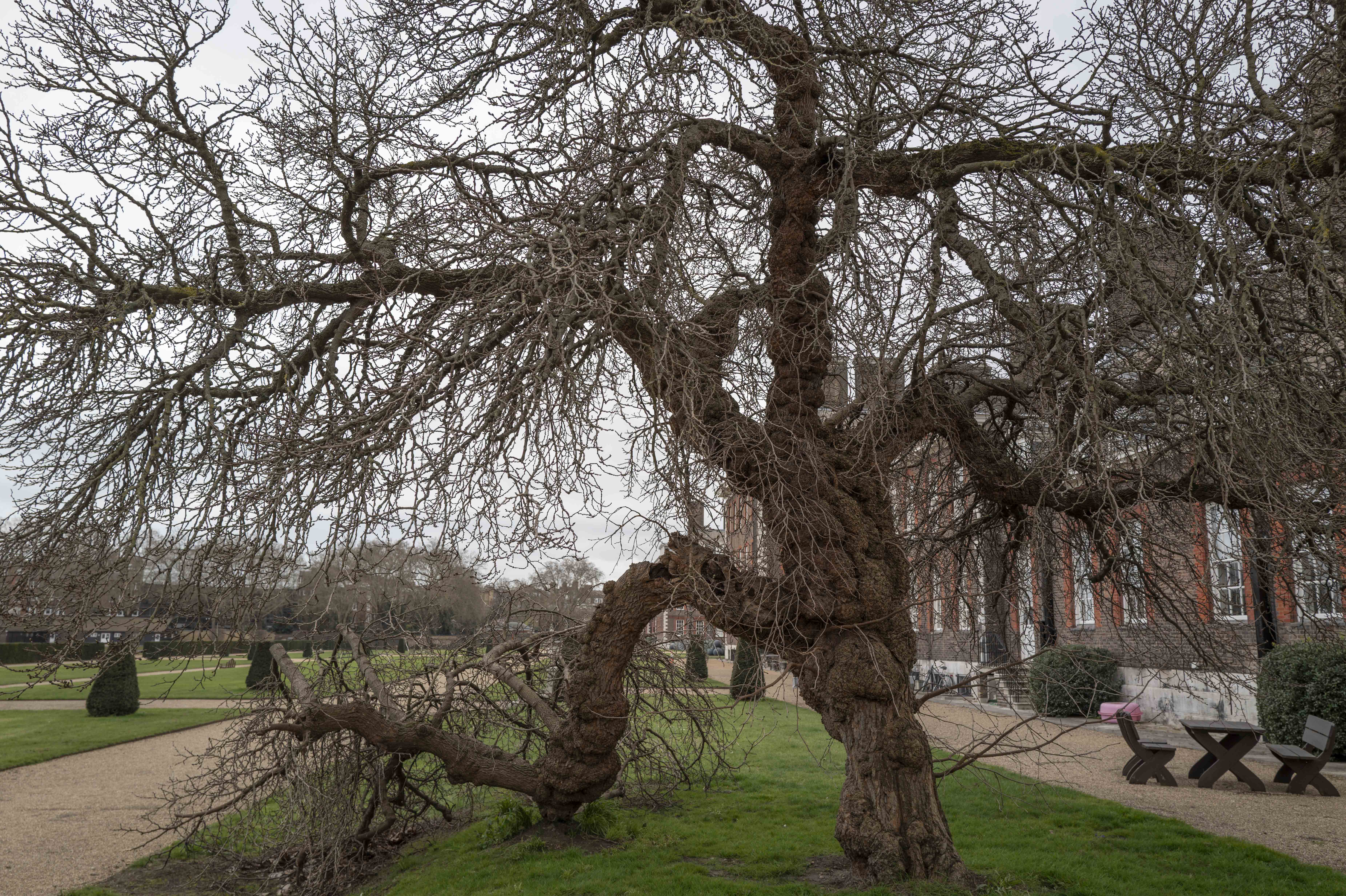
The mulberry on 24 March 2025
The mulberry is one of two that were planted in 1952, at each end of the grass terrace on the south side of the hospital, to commemorate the coronation of the late Queen Elizabeth II. The other tree has since been felled and replaced by a mulberry sapling. Ric insists that the mulberries from “his” tree are the best he’s ever tasted and tries to get to them before the pigeons and parakeets.
The carpe diem lesson of not leaving it too long to visit an old mulberry has been well learned. Compared to other trees mentioned here, the tree is still a relative youngster, at 75 years, but is showing normal signs of ageing. It was a timely meeting for me, with both tree and Ric. He’s now tied up till the end of May preparing for the RHS Chelsea Flower Show – while the mulberry will soon be covered in foliage, hiding its graceful bow to the river.
The Southover Grange mulberry in Lewes
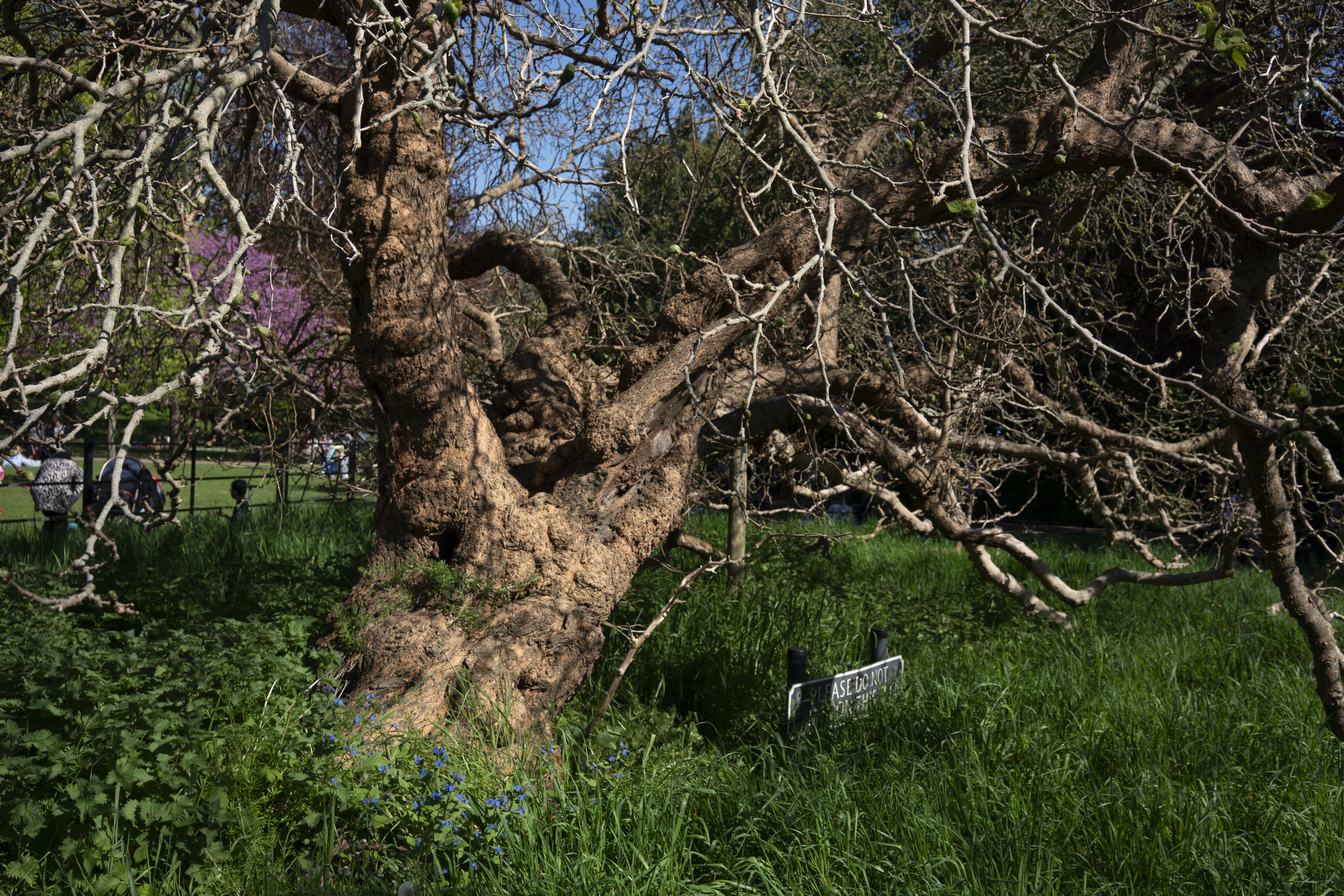
The black mulberry at Southover Grange could be 300 years old ... or more
Just as I though this newsletter was ready to go, I visited another historic old mulberry tree, at Southover Grange in Lewes (East Sussex) in the company of Mark Divall, former gardener at nearby Charleston House. Too majestic not to include, with a girth of over 3 metres, it probably dates back to the 17th century, with claims to be even older.
Spotlight on Essex
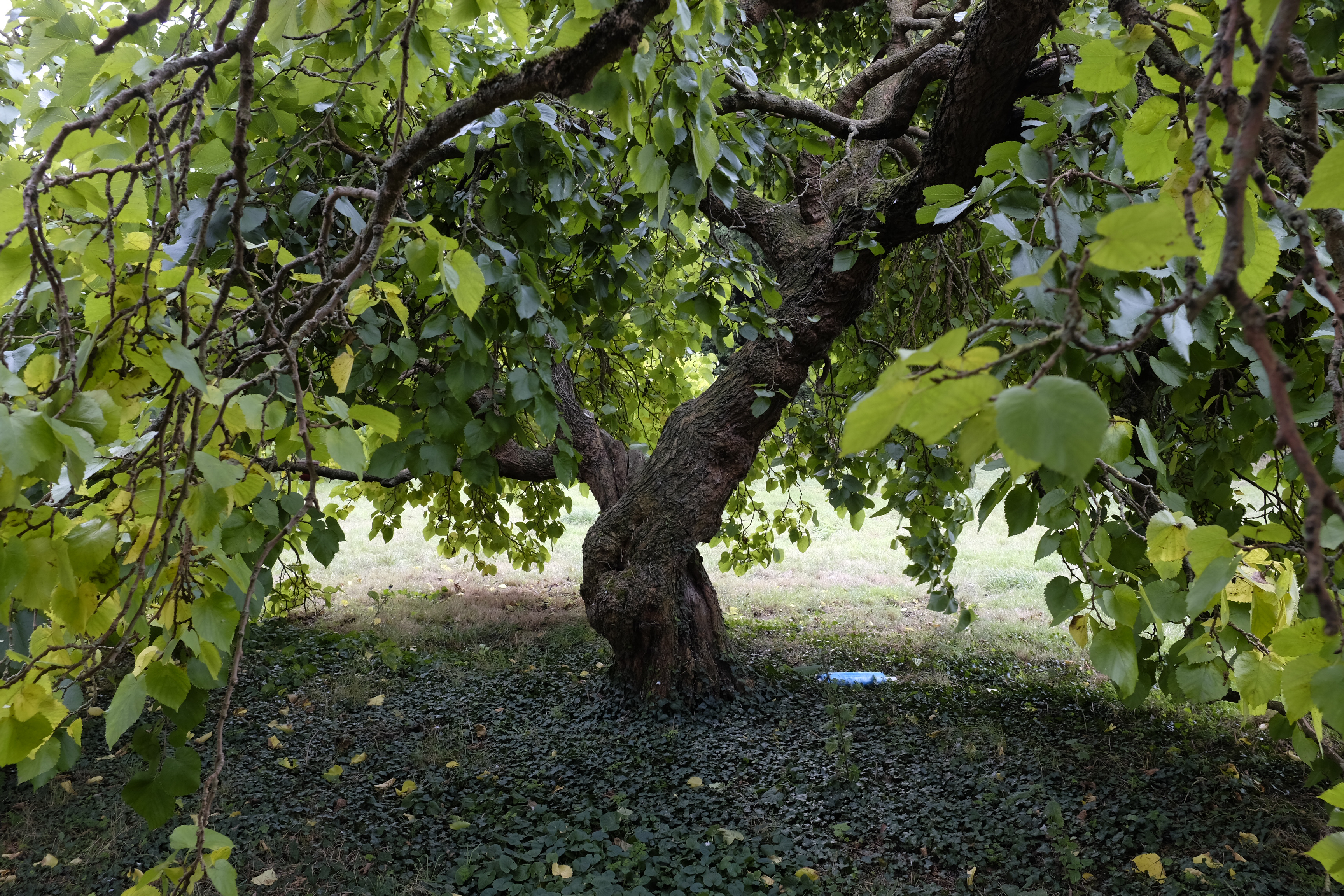
Wilkinson’s unique mulberry orchard at Tiptree (Essex)
To end with hot news – The Conservation Foundation has just been awarded a grant from the Essex Heritage Trust (EHT) to enable the Morus Londinium project to uncover the county’s hidden mulberry tree heritage. Starting with just a few existing notable Essex mulberry trees on our map, we are keen to hear about any others, young or old. So please contact us via the website, or info@moruslondinium.org if you know of one. Grateful thanks to EHT at the start of what we’re sure will be a new adventure. Watch this space – and our map and blog – for more Essex mulberries as they emerge.
Upcoming events: Urban Tree Festival
May sees the return of the Urban Tree Festival, started on a shoestring back in 2018 by tree enthusiasts Andrew Stuck, Mel Sutton, Paul Wood, and Morus Londinium’s Peter Coles. It has now become a major annual event also running in other cities besides London.
The festival lasts from 9th – 17th May and features a host of wonderful and fascinating events, led by tree experts, artists, writers, musicians…
On 13 May Peter will be leading a walk around Gunnersbury Park, highlighting its two mulberry trees (one a so-called Paper Mulberry) and paying homage to its veteran yews, cedars, oaks and other magnificent trees.
On 17 May, Peter will lead a walk around Golders Hill Park, which he has known and loved for over 45 years. Highlights include several veteran trees: a centenarian mulberry, ancient oak, sweet chestnuts, veteran pear trees and many other beautiful specimen trees. Peter will also point out some of the main top-fruit species in the orchard, with some pear trees surviving from Victorian times.
Check out the full programme here:
https://urbantreefestival.org/the-programme-2026
All photos © Peter Coles, unless otherwise credited.
Visit the Morus Londinium mulberry heritage project website