21st December 2025

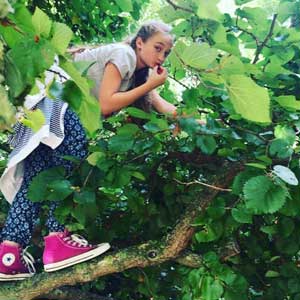
Foraging in July
While many mulberry enthusiasts relish the brief summer months (July and August) when the fruit is ripe and there for the picking, I also always look forward to winter and early spring. From November to April there are few leaves on the trees, bar a few golden stragglers at year-end, revealing the often impossibly twisted and weathered architecture of an old black mulberry tree (Morus nigra). Even a 75 year-old mulberry can look like a veteran, fooling many an amateur into believing it must be at least twice, if not three times as old.
This is the time of year that I am often out and about with my camera, notebook, and measuring tape.
But as the year draws to an end, the daylight shrinks to a minimum, and I hunker down till 2026, it seemed like a good time to look back at some of the mulberry project highlights of 2025.
Growing steadily
Morus Londinium officially launched in Spring 2016, with a Heritage Lottery Fund grant to the Conservation Foundation for 18 months. Since 2018, funding has been intermittent, but since the kernel of the mapping part of the project – the identities and coordinates of UK mulberry trees – is volunteered by ordinary citizens (you and me), the project has continued to grow, with new trees (old and young) being mapped almost every week, sometimes with fascinating stories attached.
1284 RECORDS, NATIONWIDE, TO DATE

The project’s original remit was to document mulberry trees in the Greater London area, specifically within the M25 motorway. This is still where most of the recordings are concentrated, with 865 having been mapped in this London-centred circumference, to date. But, as the map shows, we are gradually expanding our coverage, and this will increasingly be the focus in the future.
This expansion has been greatly helped by a few intrepid supporters of the project who continue to provide new entries and to facilitate access with owners locally to enable the project to follow up with a much-valued site visit.
St Albans area

St Peter’s Close, St Albans
In 2025, St Albans residents Anthony Helm and Kate Bretherton made a concerted effort to uncover and record mulberry trees around the Roman city of Verulamium (i.e. St Albans), inviting me a couple of times to share what they had found. Kate is already an authority on the city’s trees, with a revised edition of her essential book, The Remarkable Trees of St Albans available. I spent my teenage years in Hatfield, Welwyn Garden City and St Albans, so have been able to look at familiar places with new eyes. We even had the privilege of visiting the private gardens of Mackerye End House at the invitation of owner, Graham Penn, with his handsome mature mulberry tree, and potential champion trees.
East Anglia
The work and enthusiasm of Anthony and Kate is a model we are hoping to replicate elsewhere, developing what we might call “hubs” of local expertise and support, documenting and preserving our national mulberry tree heritage. Tree Register honorary director David Alderman and volunteer recorder Judy Dowling have been contributing fascinating old mulberry trees in this spirit for much of the project’s lifetime, but without a specific geographic focus.
We made a start with the idea of “hubs” back in 2024 with a focus on the silk-weaving town of Sudbury, thanks to local artist Ruth Philo, who has long been interested in the relationship of local silk weaving to its mulberry tree legacy.

Black mulberry in North Norfolk
The relationship of mulberries to silk and the silk roads had already been the focus in 2023/24 of the Nara to Norwich exhibition and textile conference, as well as a short piece on the Morus Londinium website. Peter Coles and Morus Londinium are affiliated to the Sainsbury Institute for the Study of Japanese Arts and Cultures (SISJAC), via long-standing Morus Londinium friend Professor Susan Whitfield and SISJAC director, Simon Karner..
Memorial Mulberry in Flanders
June was an especially memorable month for the mulberry project when Peter, representing Morus Londinium, was invited to be part of a symposium on memorial trees, centred on a veteran black mulberry tree in the Belgian town of Sint Niklaas which has been designated by residents (and the action group STOFF) as a memorial to the many local people who have suffered illness and died through asbestos-related cancers attributed to a factory in the town. The new friends I made there – and shared a platform with – have had a radical effect on my thinking about trees and living monuments.
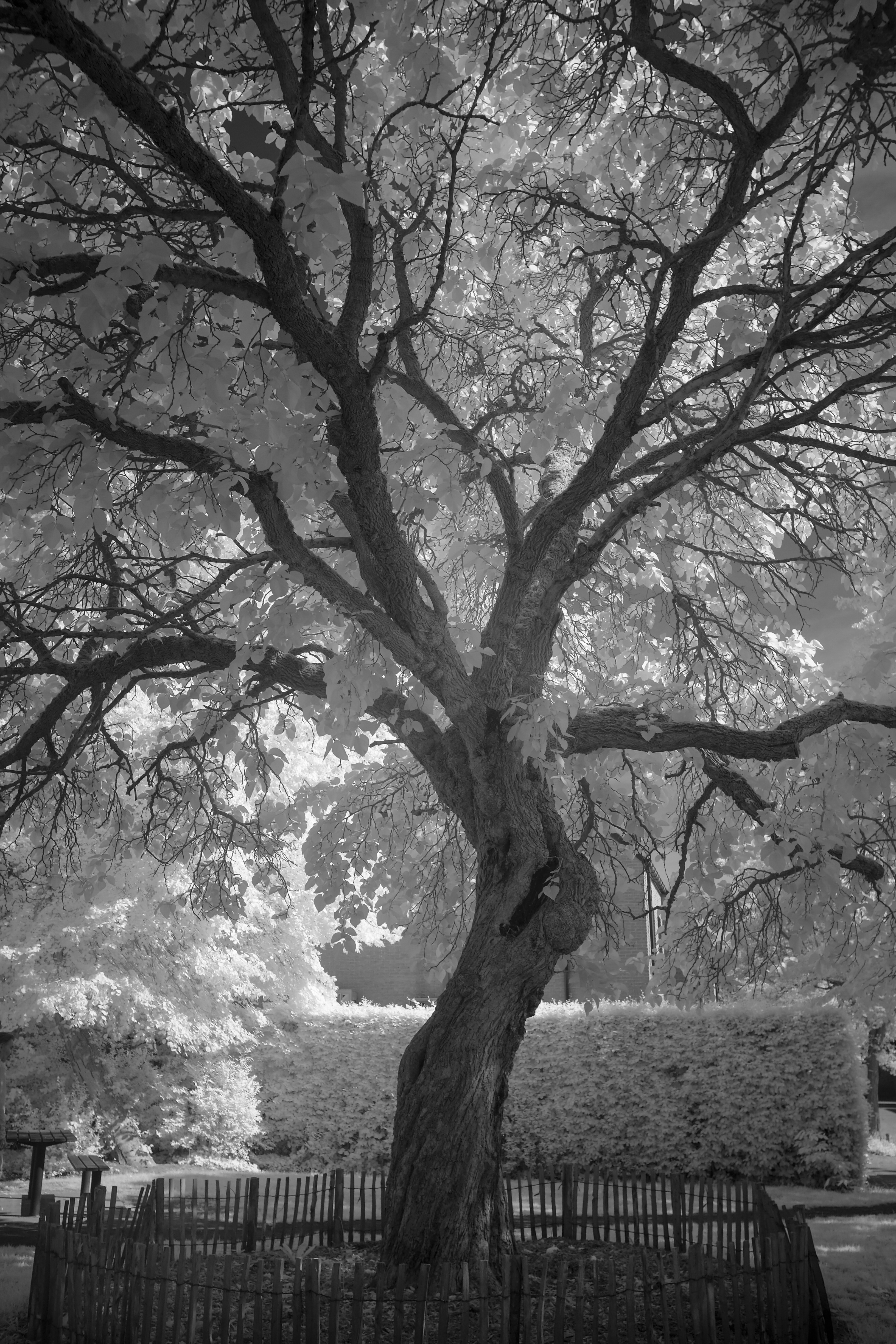
Asbestos Memorial mulberry in Sint Niklaas (Belgium)
Isle of Wight
One of the star achievements for the project in 2025 has to be the mulberry recordings on the Isle of Wight being championed by Chris Kidd, Curator at Ventnor Botanic Garden. Chris has set himself the task of documenting the Island’s mulberry tree heritage (and beyond) and has already unearthed dozens more than he anticipated (over 35 to date), with new trees still emerging. I joined Chris for a memorable week of mulberry hunting in early September – with a return visit being planned for early Spring. 2026 I can’t wait.

Focus on Chelsea
The Royal Borough of Kensington and Chelsea (RBKC) has an unusually large number (over 20) of old – and some ancient – black mulberry trees. Nearly all have remained hidden from view in private gardens since they were planted, some with roots in the 16th century. Thanks to the support and enthusiasm of local residents, Morus Londinium has been invited to see several of these trees and add them to the map, with an account of their stories.
In January Peter was invited to give a talk to the Chelsea Gardens Guild on the Royal Borough’s mulberry tree heritage. This led to some wonderful discussions and follow-on after the meeting, with more hidden mulberries revealed thanks to residents, notably Sue Snell, Roddy Mullin and Denis Strauss. Another talk followed later in the year at the Moravian Burial Ground on Milman Street, thanks to local historian and Sir Hans Sloane biographer Ian Foster.

Sir Peter Bazalgette planting a mulberry on Chelsea Embankment
And, in November I was invited by the Cheyne Walk Trust to the ceremonial planting of a white mulberry tree in Cheyne Walk Gardens, a stone’s throw from the Thomas More statue. The tree was planted by Sir Peter Bazalgette to commemorate the 150th anniversary of the completion of the Chelsea Embankment by his great great grandfather, Sir Joseph Bazalgette. Thanks to Roddy Mullin and Colonel David Waddell of the Cheyne Walk Trust for inviting Morus Londinium to the lecture and reception afterwards.
The last lecture of the year was one that I thoroughly enjoyed putting together, for London Parks and Gardens, at the Garden Museum in South Lambeth. This gave me an opportunity to share some of the fruits of my research (sorry for the pun) on the John Tradescants (father and son) and their connections with mulberry trees. I will be publishing something on this early in the New Year.
More Walks, talks and foraging
The second half of 2025 was a bit limiting for me as I had two rounds of surgery and subsequent recovery periods, even if the procedures were straightforward. But the summer was glorious. We had good weather and this was an exceptional year for black mulberry fruit. So, on some memorable foraging walks in the City, around St James’s and the Inns of Court, we were able to feast on superb fruit and even get to compare their tastes.
2025 also saw documenatry film producer Tony Eva edit the final cut of his film on the so-called Milton Mulberry at Christ's College, Cambridge, in which Morus Londinium features - see the trailer here.
Looking forward to 2026
Earlier in 2025 I was asked to give a talk to pupils at Orleans Park School near Twickenham. I confess to being a bit nervous, as I’m more used to talking to an adult audience with more than a scattering of senior citizens than 11-18 year-olds. But the students’ questions were spot-on and I am very much looking forward to another school talk in 2026 if it can be arranged. We are hoping to extend greater outreach to schools, to promote more opportunities for young people to dig deeper into the ways that old mulberries can be living links to present and lost heritage. Former Deputy Head of History at Orleans Park, Barbara Trapani, is pioneering this approach to blending history teaching with environmental awareness in the face of climate change.
The coming year looks like one of both consolidation and expansion. The Conservation Foundation will be highlighting its work across selected Heritage tree species – Elms, Yews and Mulberries – while Morus Londinium, under the Foundation’s aegis, will be expanding further across the UK through the regional ‘hubs’ which we hope to develop. We will also be starting a regular Substack, just waiting for the right moment.
Meanwhile I wil be leading new walks throughout the four seasons and hopefully will have the opportunity to give more lectures and podcasts.
All photographs (c) Peter Coles
Happy Winter Solstice!