| Location | Oalands Drive,, Weybridge |
|---|---|
| Variety | Nigra |
| Access | Garden |
| OS grid reference | TQ 08546 65221 |
| Largest height (m) | 15 |
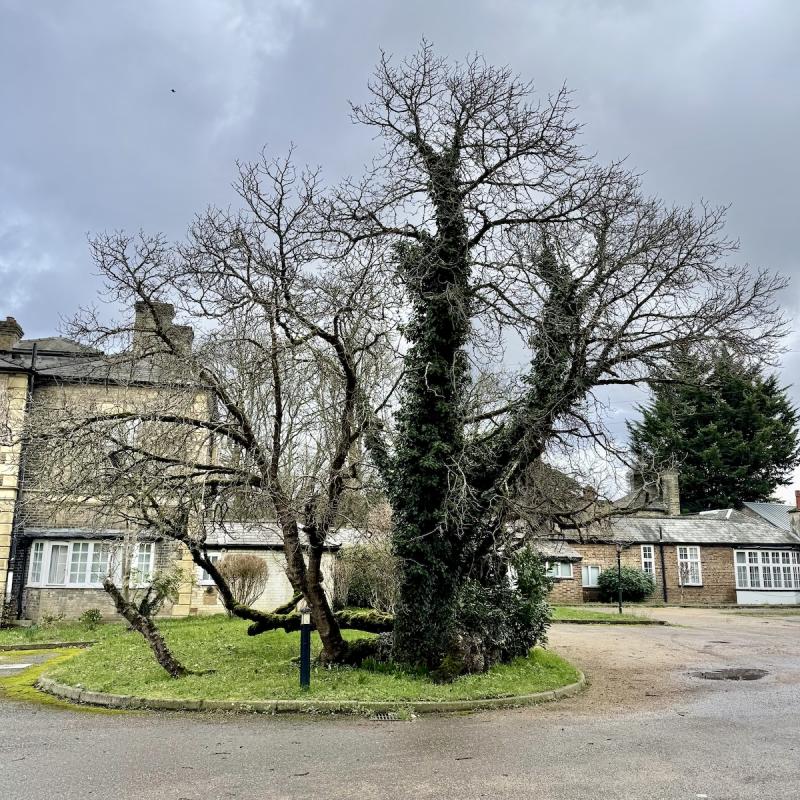
A surprisingly tall black mulberry tree in the rear car park of Oatlands Park Hotel. (Please seek permission from the lobby for access.) The tree probably dates from about 1856 when the hotel was remodelled.It stands near to the former stables, which are among the oldest parts of this site. There are several other remarkable trees in the hotel grounds, including one of the first cedars of Lebanon to be introduced to Britain, celebrated in a watercolour by Victorian artist and poet Edward Lear (author of The Owl and the Pussycat). nearby is the county and national girth champion Red Oak, probably about 250 or more years old. (see https://www.treeregister.org/champion/tree?s=106680) The Hotel manager understands the mulberry tree was blown over in the 1986 hurricane, but it may have split and partly collapsed from root compaction from the car park and adjacent roadway, as well as structural tree work at some point.. The tree is vigorous nevertheless and a strong layering new stem is growing from the bole a few metres away, striking out as a possible future tree.. There is competition from laurel and shrubs under the canopy, as well as ivy up the main trunk, which could be addressed to preserve the tree's longevity. The magnificent Grade II listed 4-star hotel has an illustrious history stretching back to the 15th century. In 1538 Henry VIII requisitioned a former Manor House and estate here and built a palace for Anne of Cleves his fourth wife, although the marriage was annulled after 6 months. The Tudor palace stood further down the hill to the west from the present hotel. After the execution of Charles I the palace was sold and demolished by the new owner around 1649 . The Hotel stands on the site of the only buildings surviving from the Tudor and Jacobean palace estate. The site of the old palace and gardens are now a housing development, with street names alluding to its past (Tudor Walk, Palace Gardens, etc...) In the time of James I and Queen Anne of Denmark, there was a mulberry tree plantation here and a silkworm house designed by celebrated architect Inigo Jones. The site of the mulberry garden is remembered in a street name: "Mulberry Close". The Hotel mulberry tree could have its origins in an older tree on the site from this period, of course. Celebrated royal gardeners John Tradescant senior and his son were gardeners to Queen Henrietta Maria here from 1630-1638 and introduced several exotic plants from their travels. Oatlands Park Hotel is fascinating in its own right. From 1689 onwards converted buildings from the demolished palace estate were leased to the 7th Earl of Lincoln. The house passed to the Duke of York but burned down in 1794 and was rebuilt in the Gothic style. The then Duchess of York retired here until her death and created the dog's cemetery, which can be seen today. near to the hotel entrance The remodelled building became a hotel in 1856, and had many famous guests, including French novelist Emile Zola, in exile from France. The hotel 's Mulberry Restaurant, overlooking the lake, celebrates both the veteran mulberry tree and the 17th century mulberry gardens that once stood on the former palace estate. Lunch, afternoon tea and dinner are served in a sumptuous setting.

View more mulberry trees

We need your help to update the National Biodiversity Network

Learn the signs to spot a mulberry