19th August 2026
By Peter Coles
I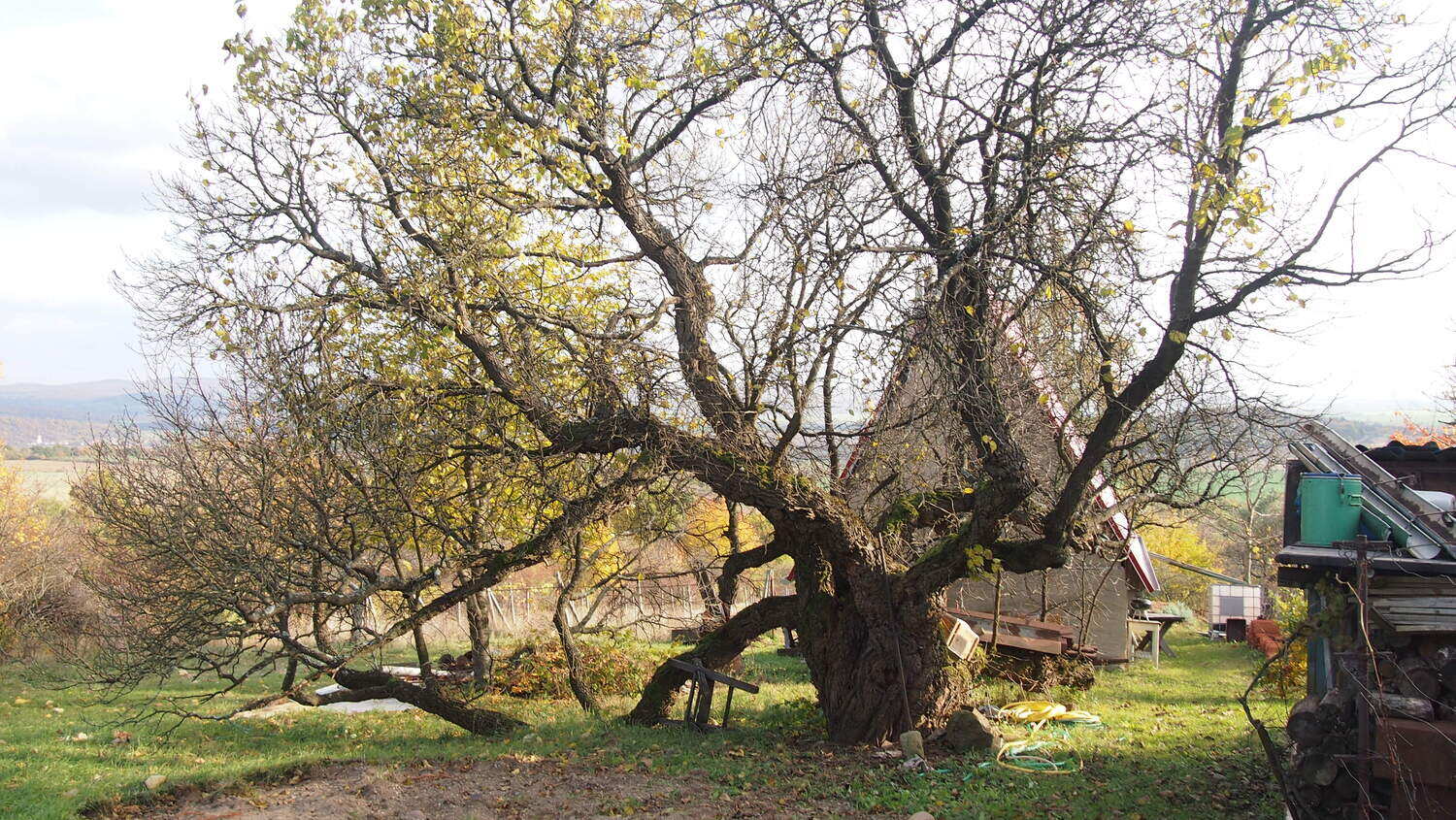
Veteran black mulberry in Pukanec (photo Miloslav Bahna)
In February this year, Morus Londinium received an email out of the blue from Miloslav Bahna, a researcher based in Bratislava (Slovakia). It began:
“For several years I have been reading your stories about mulberry trees in London and elsewhere in Britain. […] Recently, I noticed you started to write about places outside of Britain linked to mulberry trees.
I thought you might be interested to learn more about the unofficial black mulberry capital of Central Europe – the village of Pukanec in Central Slovakia, originally a royal [silver and gold] mining town. The vineyards of this village with a population of 1,700 inhabitants harbour the largest documented concentration of black mulberries in Europe, counting 470 trees, many of them veteran trees assessed to be up to 300 to 500 years old. Further dozens of trees can be found in the neighbouring villages; otherwise, black mulberry is very rare in Slovakia and is limited to wine-growing areas.” […]
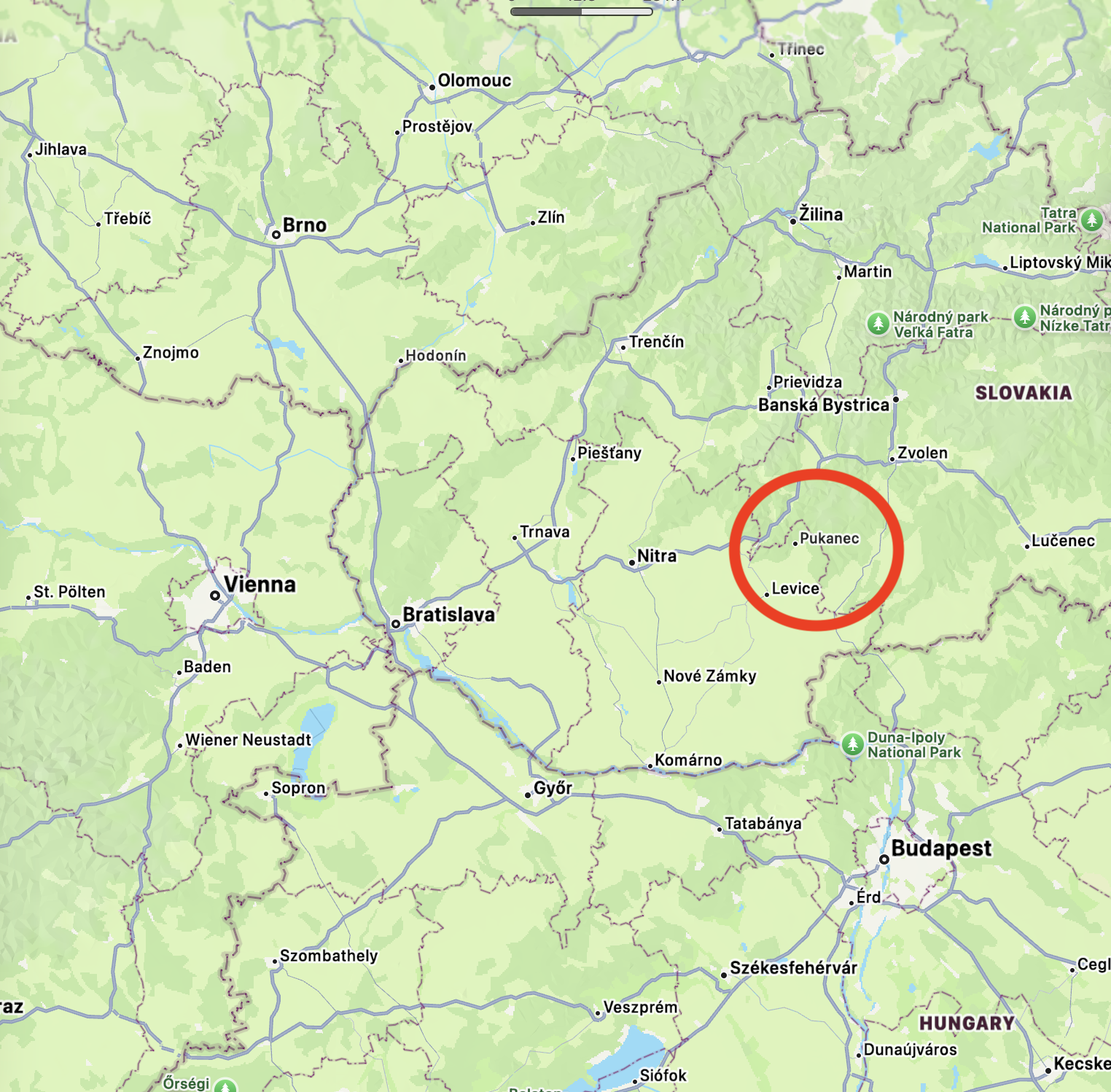
“For years the locals have cared for their black mulberry trees which grow in the vineyards around the village. The mulberries were declared a protected natural site in 1988 and a mulberry educational trail was established in 2018. Since the same year, Mulberry Days have been organized in Pukanec and in the surrounding villages. In 2026, the festival will be held in Pukanec on July 25. If interested, we would be pleased to welcome you in Pukanec. I include a few pictures of the trees and a map of the trees in the vineyards to get a better picture”.
I immediately responded, saying I’d be delighted to come to Pukanec for the Festival and to see some of the ancient black mulberry trees around the town. I didn’t know how I’d finance the trip but had decided to go and see for myself anyway.
Five months later, thanks to a travel grant from The Kew Guild and additional support from the Conservation Foundation, I found myself sitting at a terrace in the centre of Pukanec with Miloslav, his wife and son on the eve of the festival, having a meal and sipping the Slovak challenge to Coke, named Kofola – a drink I came to enjoy as much if not more than “The Real Thing”.
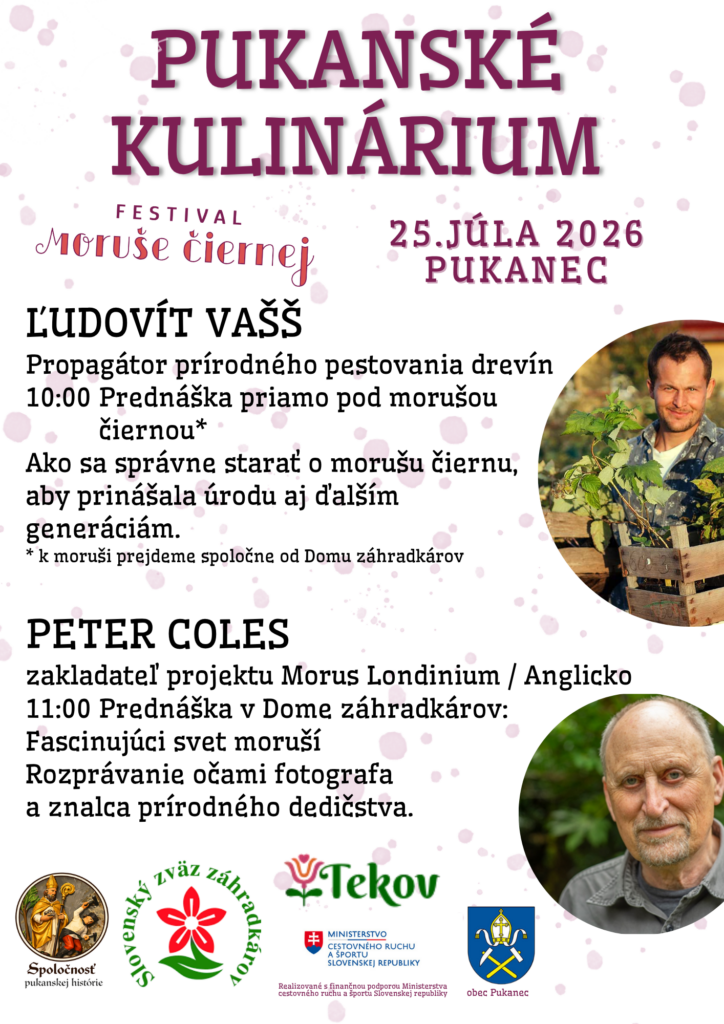
The Bahna family would be manning a stall at the mulberry market the following morning. There would be mulberry-picking, talks, and a guided walk along the educational trail that Miloslav had mentioned in his email. Sure enough, on a noticeboard near our table on the terrace was a photo of me, alongside that of the local mulberry propagation expert, Ludovít Vašš. I was going to have to sing for my supper!
Waking up in paradise
I knew I was somewhere special when, as we had driven into Pukanec that evening, we’d passed a woman in a housecoat walking down the empty main street, her hands and clothes spattered with what looked like blood. Anywhere else, we’d have called the police, but here, this was an everyday occurrence after picking mulberries – and a scene I was to experience many times in the coming days.
The next day, for someone who has devoted much of the past 15 years to researching, photographing, writing and talking about mulberries – notably black mulberries – I felt I’d died and gone to heaven. This really was mulberry paradise. Everyone was talking about black mulberries – Moruša Cierna (Morus nigra), known locally as the “vineyard strawberry (vinicná jahoda)” because it is almost exclusively grown alongside vineyards – a practice that is centuries old.
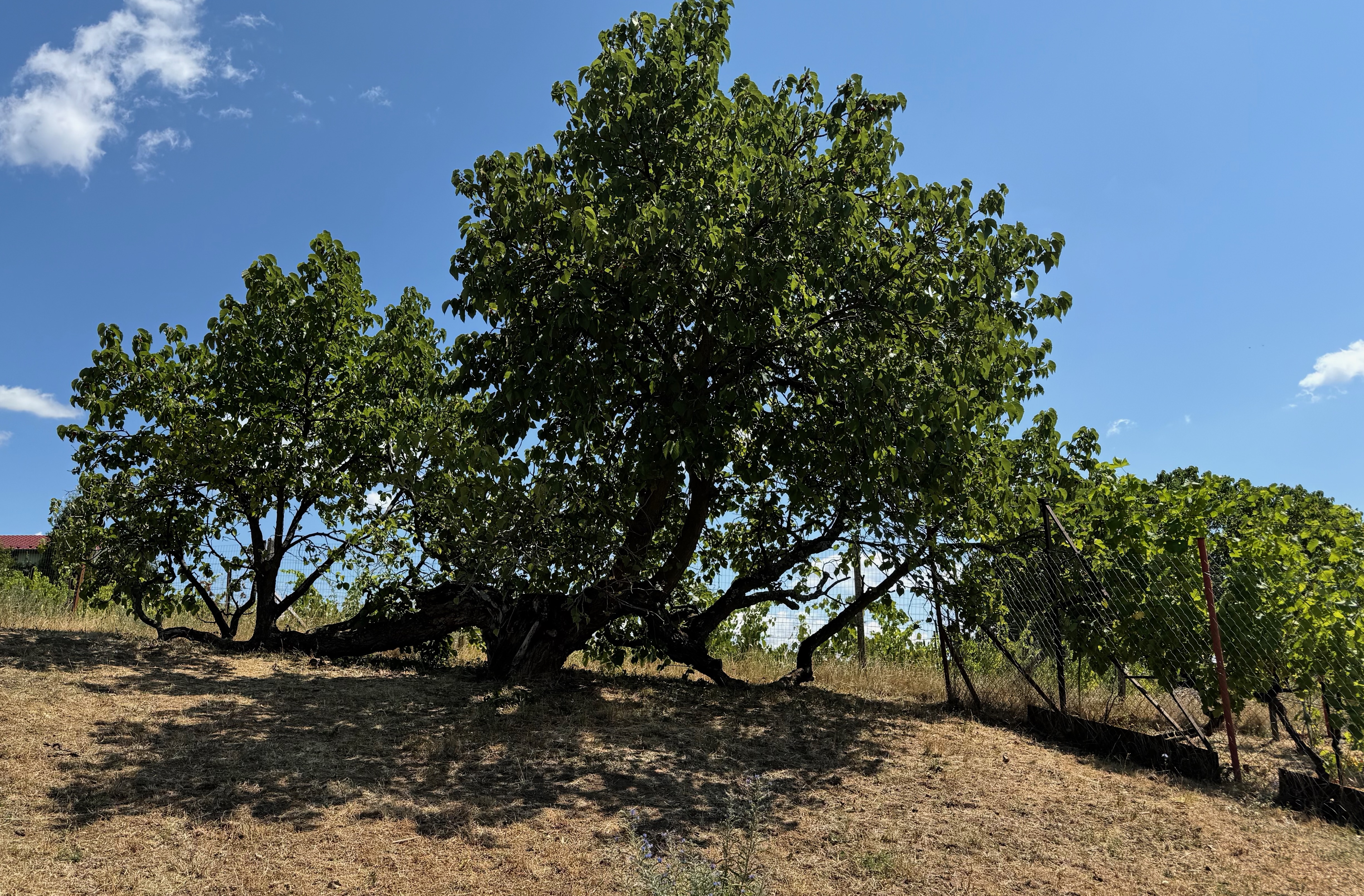
Veteran black mulberry surrounded by vineyards (photo Peter Coles)
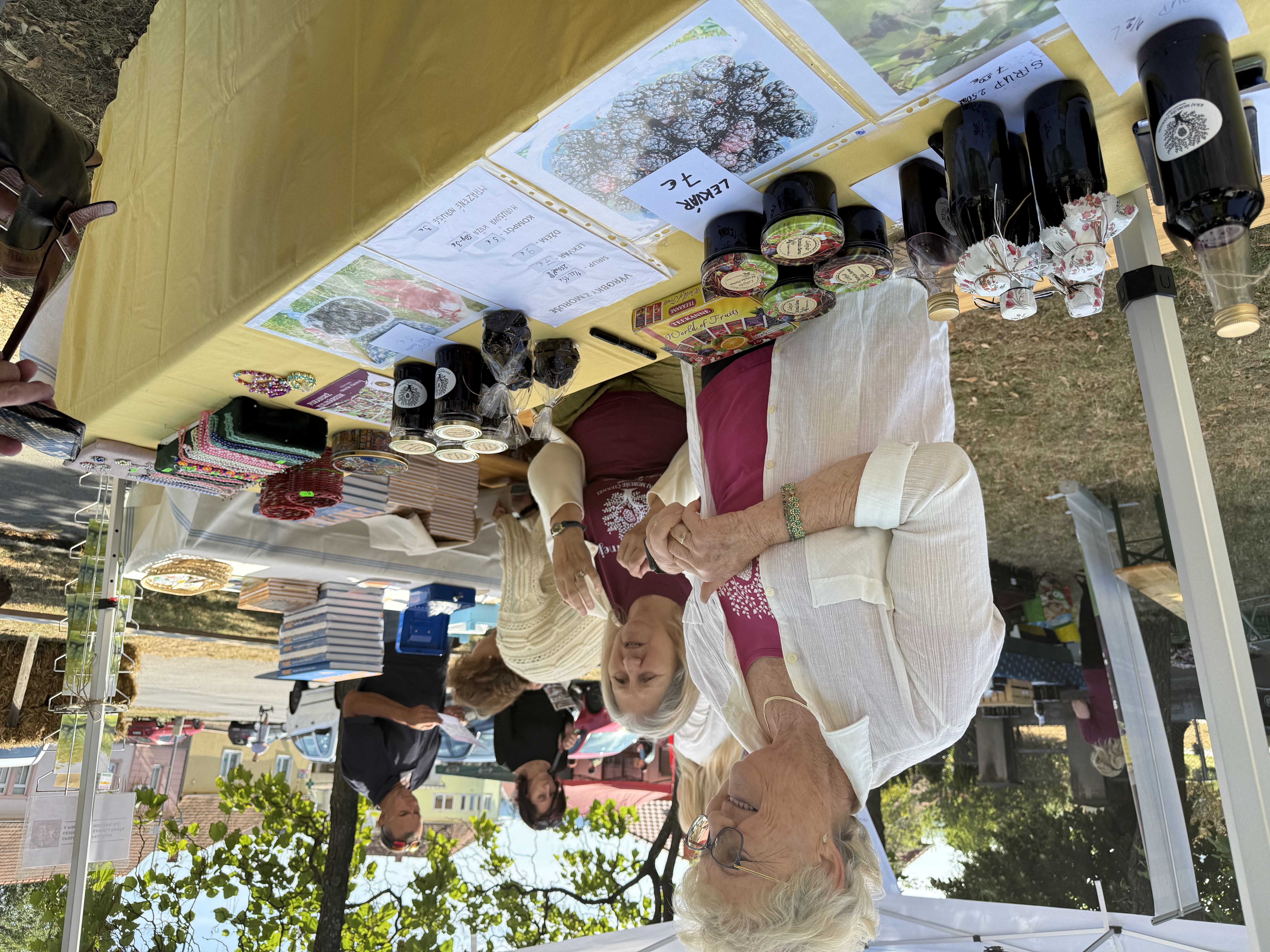
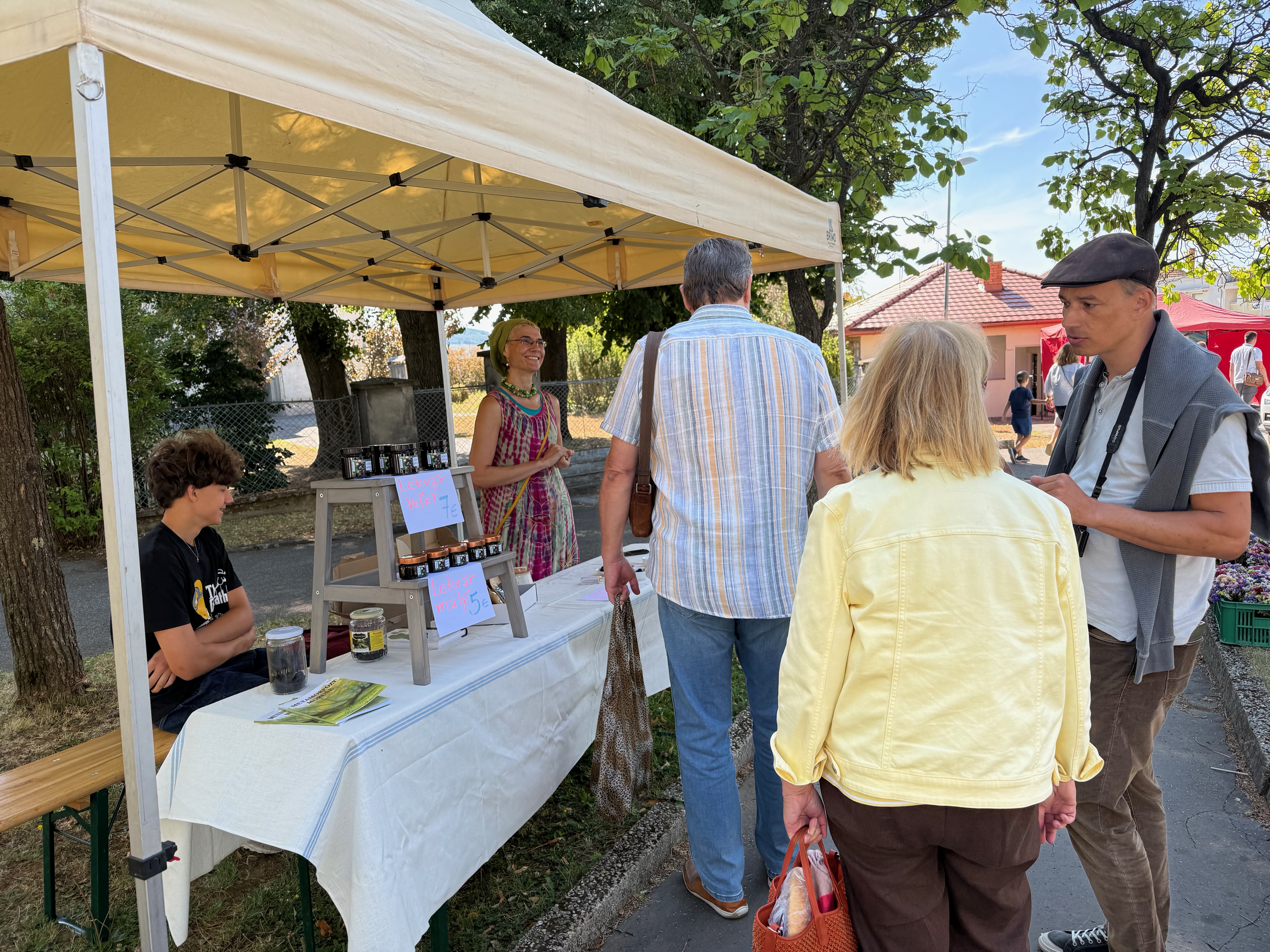
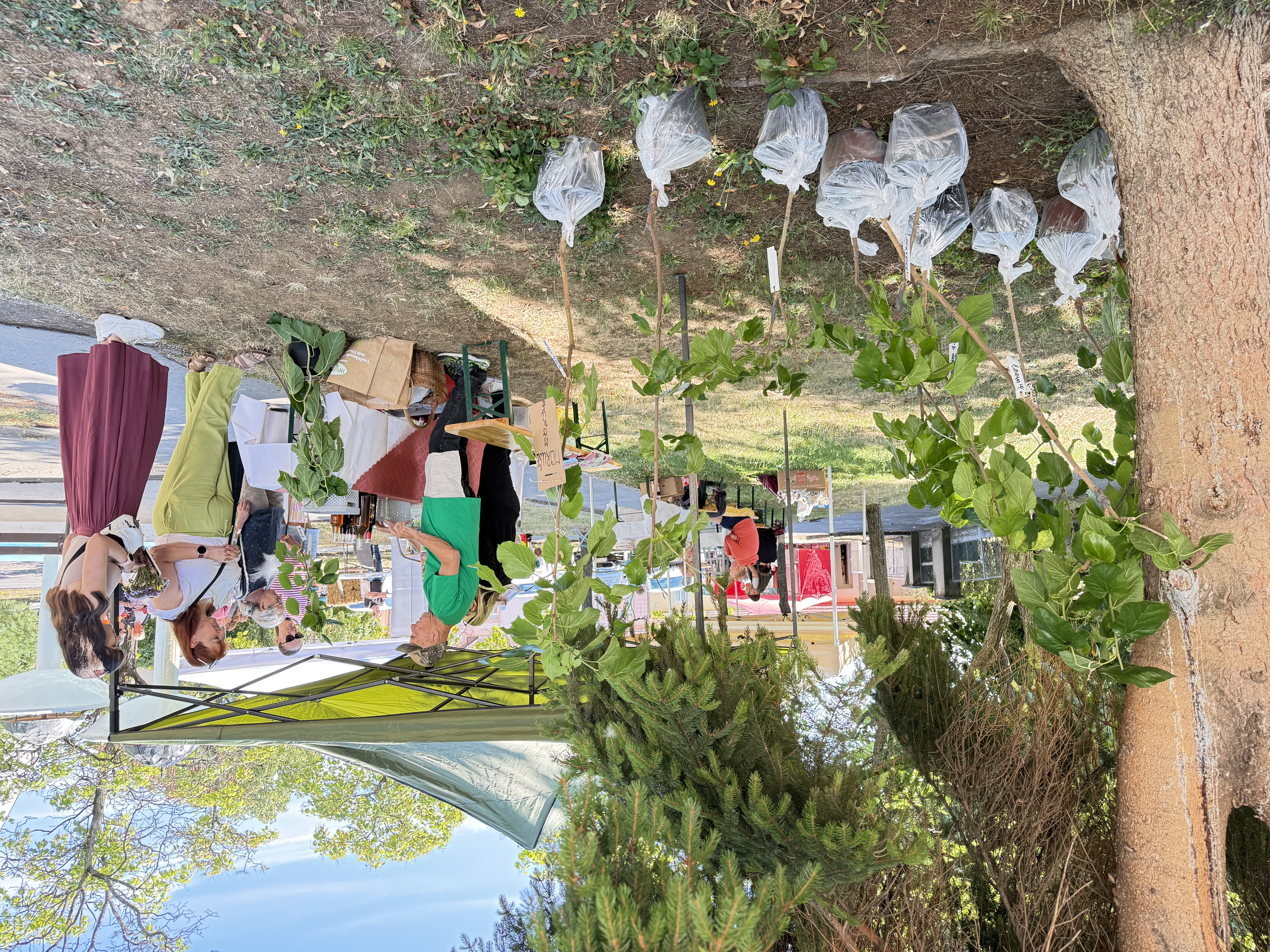
That morning the central square was filled with stalls presenting and selling all kinds of local black mulberry produce, from jams and compotes, to syrups, elixirs, seedlings, dried mulberries (Milo’s speciality), even wines and liquors, as well as T-shirts and books.
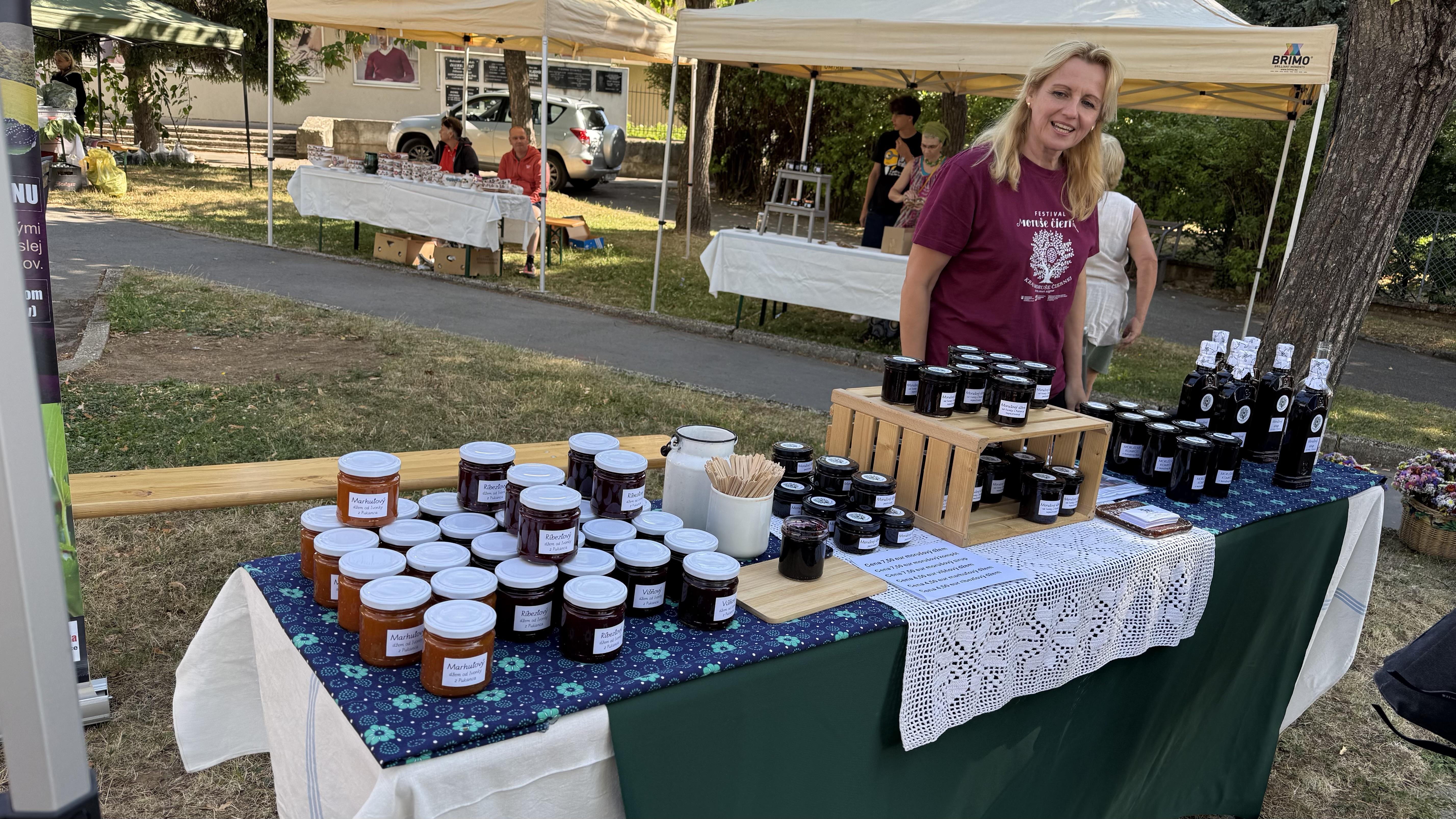
In 2024, local producer, Ivona Križanová, nominated the black mulberry for inclusion in the global Ark of Taste, an international catalogue of foods that are significant in terms of cultural heritage or biodiversity, but whose existence is under threat. It is a project of the Slow Food organisation, which was founded in 1989 by the Italian activist Carlo Petrini.
Deliciously messy morning
For a small entrance fee a few mulberry tree owners opened their gardens to festival goers to help themselves. It was quite a carnage, though of a benign and happy kind. Pickers were given local pottery cups to hold their haul. Black mulberries are notoriously fragile – even Shakespeare alluded to this in his 1607 play, Coriolanus, where Volumnia says: “Now humble as the ripest mulberry / That will not hold the handling.” Some pickers saved themselves the mess and just ate the fruit straight off the branch.
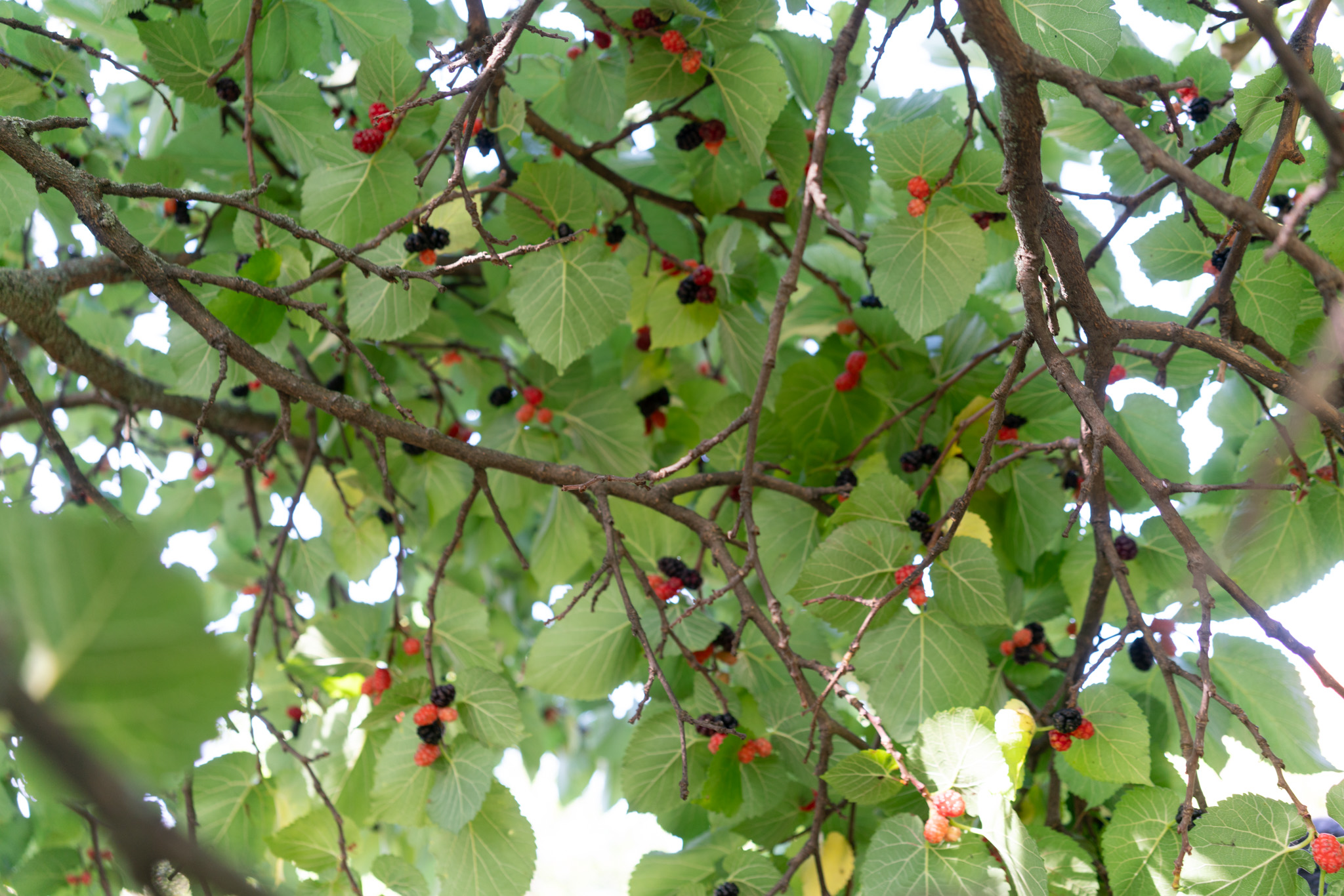
A good harvest, despite the hot, dry weather
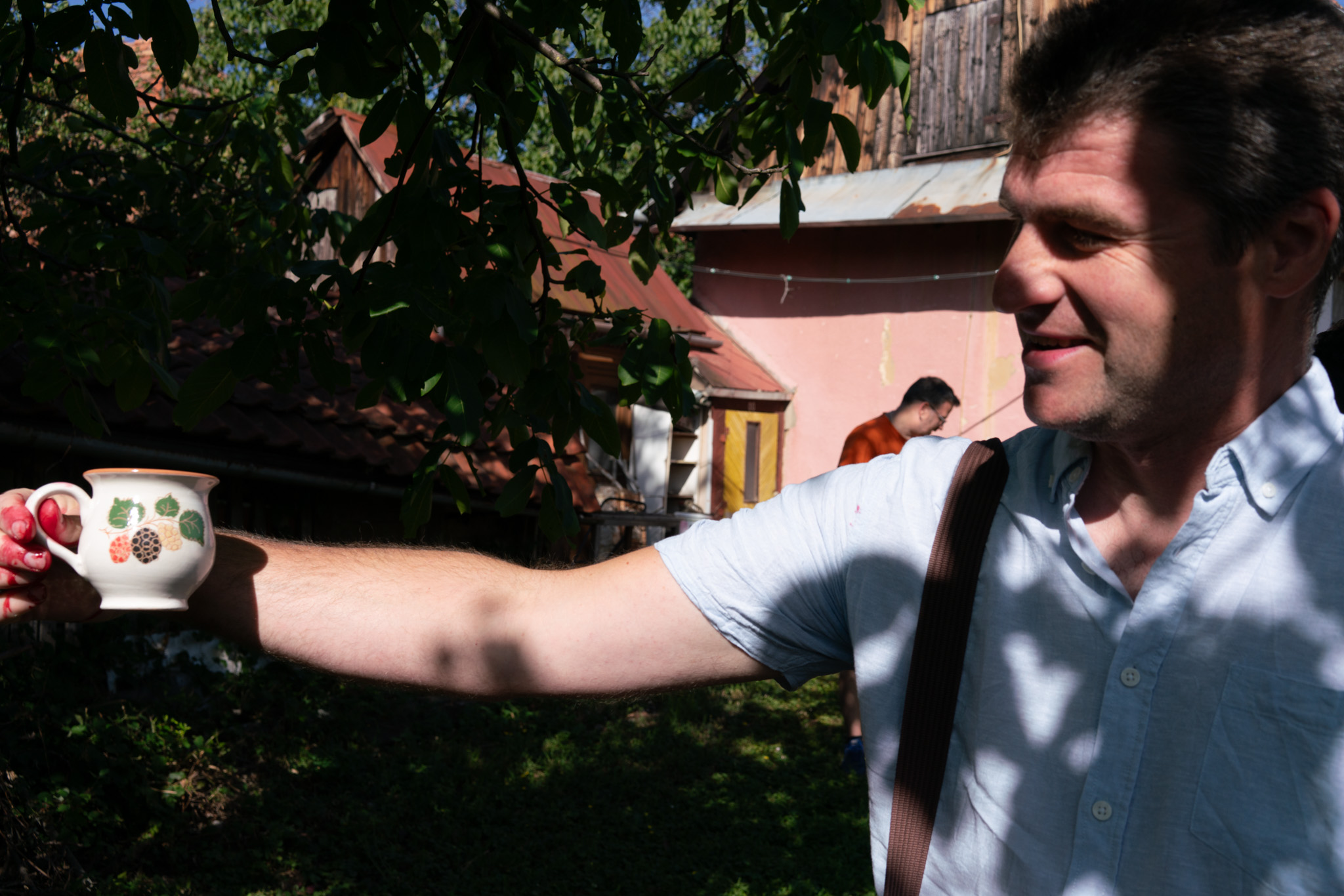
Local pottery (often a jug) is traditionally used to gather mulberries
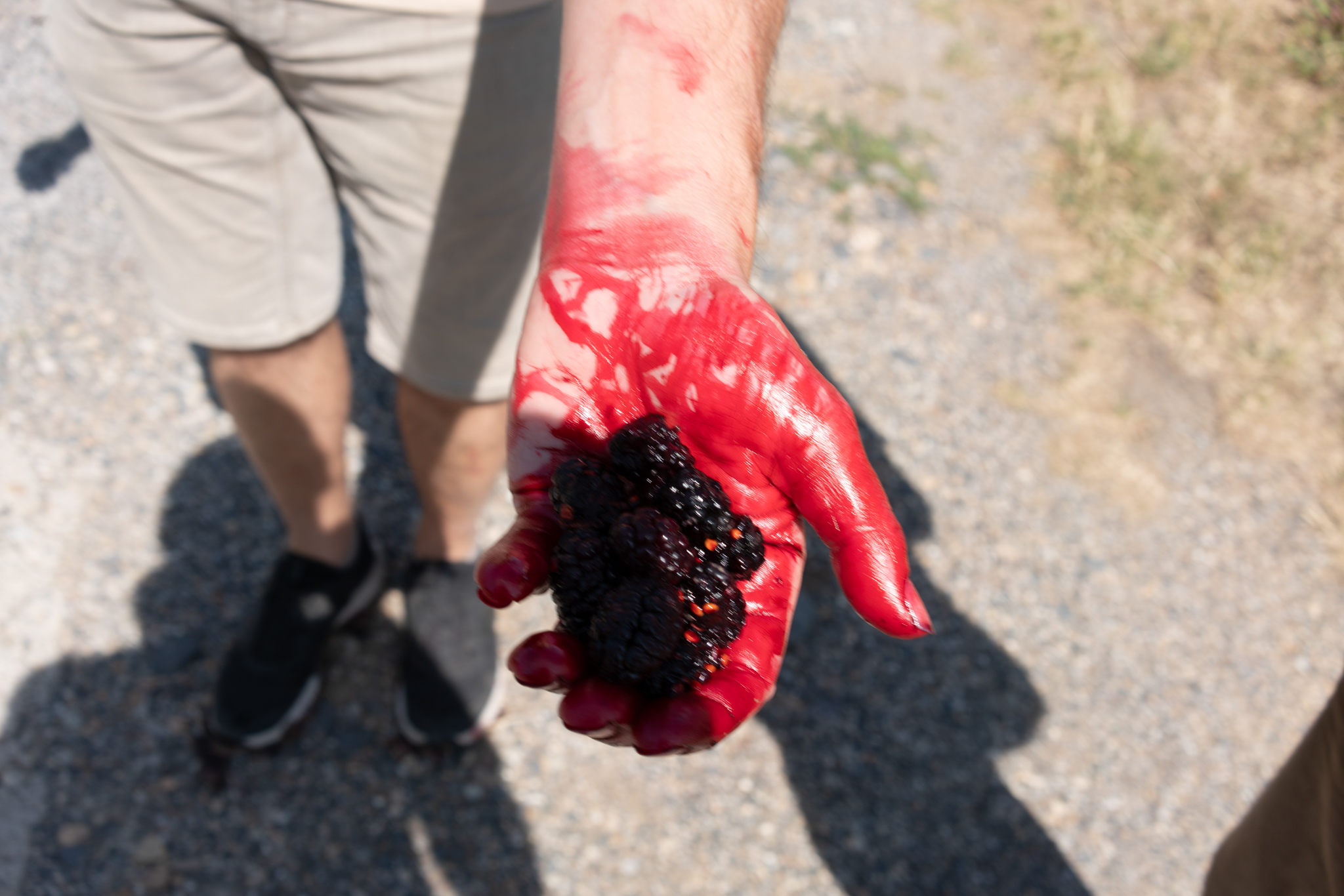
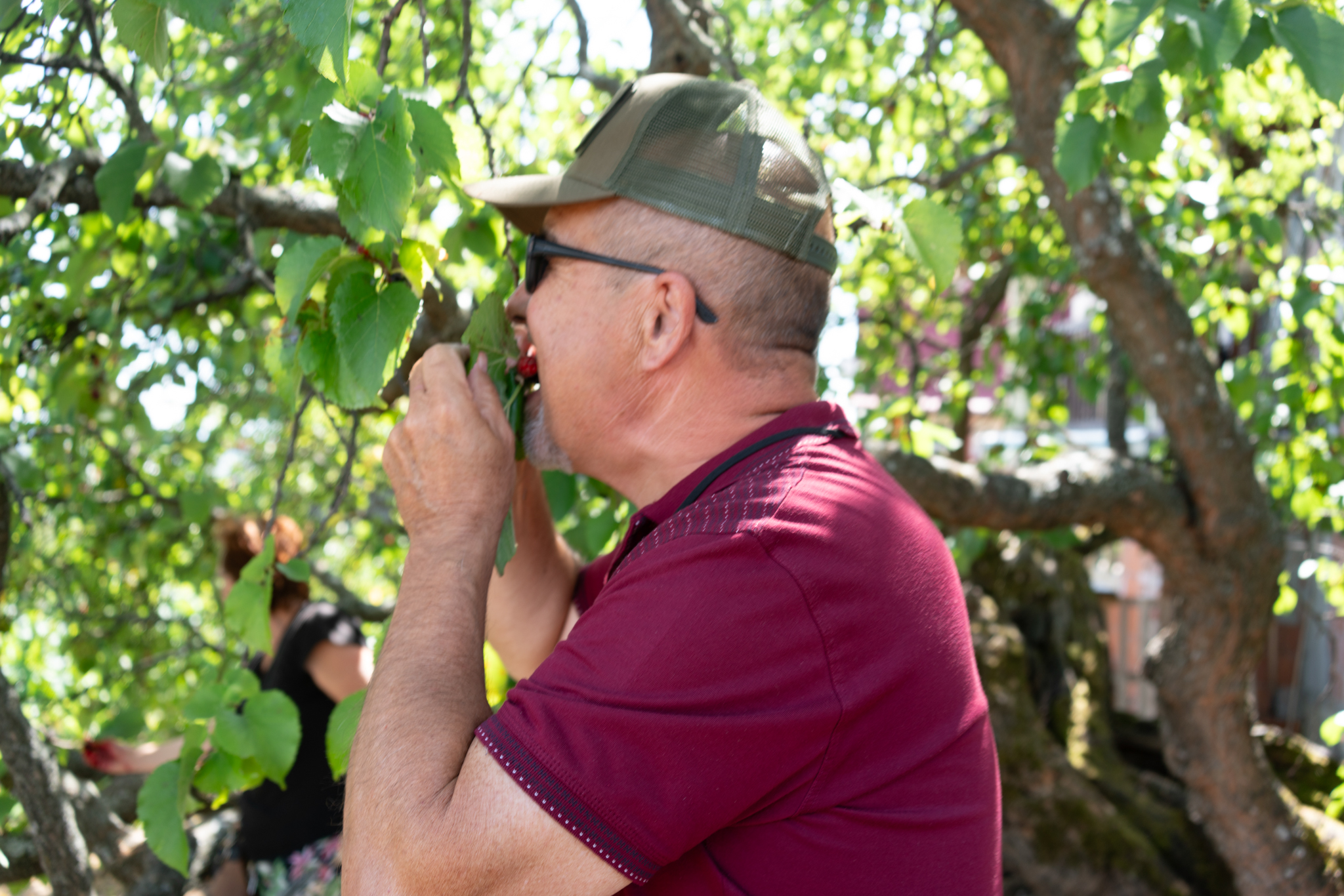
Some preferred not to get messy and eat the fruit straight off the tree
“Vineyard strawberry”
Local people have been caring for their veteran and ancient mulberry trees for generations – with more or less knowledge. Fortunately, the black mulberry is extremely resilient and, on the whole, needs little attention once stablished. Until recent decades, most Pukanec residents have been largely unaware of the uniqueness of what they have – the largest concentration of black mulberries anywhere in Europe, if not globally (over 800 trees in Pukanec and surrounding villages). They still take the old trees for granted, harvesting the fruit and making various products, which they may sell in local markets.
That said, when local nurseryman Ludovít Vašš gave a practical demonstration of mulberry propagation, around 60 people turned up eager for advice. He was at pains to point out the crucial differences between the black mulberry and black-fruited cultivars of the white mulberry (Morus alba), whose fruit is less juicy and lacks the tart sweetness of the black mulberry.
The black mulberry reproduces poorly from seed, so most nurseries propagate from cuttings. Vašš specialises in grafting the scions onto white mulberry rootstock, which grows more quickly, although it is not without its drawbacks, like the risk of an imperfect graft union.
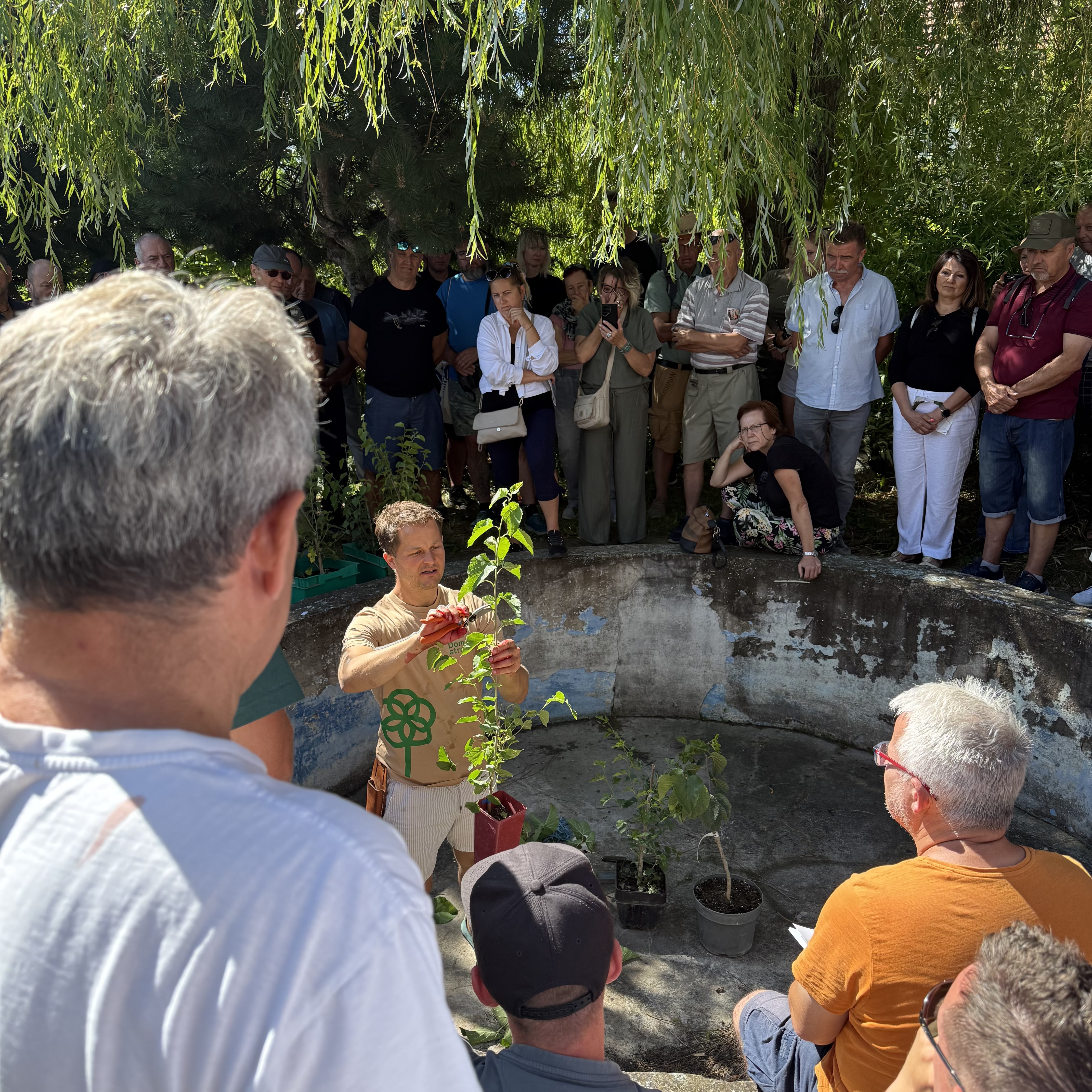
Nurseryman and mulberry expert Ludovít Vašš demonstrating propagation techniques
Mapping mulberries
It’s only in the past 50 years or so that serious attempts have been made to go beyond counting the mulberry trees in and around Pukanec, to mapping them. Miloslav Bahna has inherited his father’s passion for Morus nigra, remembering holidays in Pukanec at his grandmother’s house. Since 2016 he has been using new technologies to verify previous surveys, add photographs and integrate them on a single interactive map.
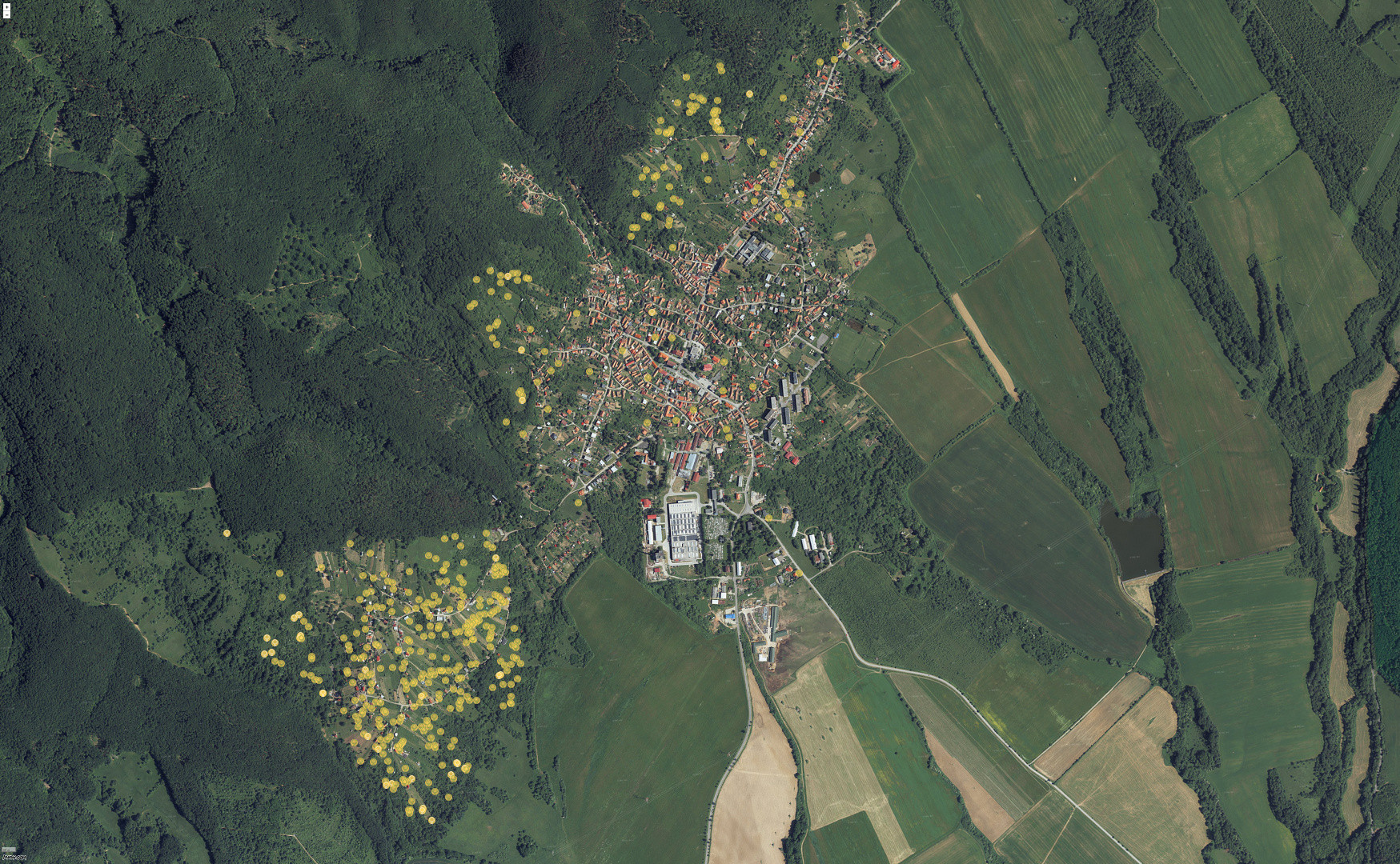
Aerial view of Pukanec mapping several of its 470+ black mulberry trees
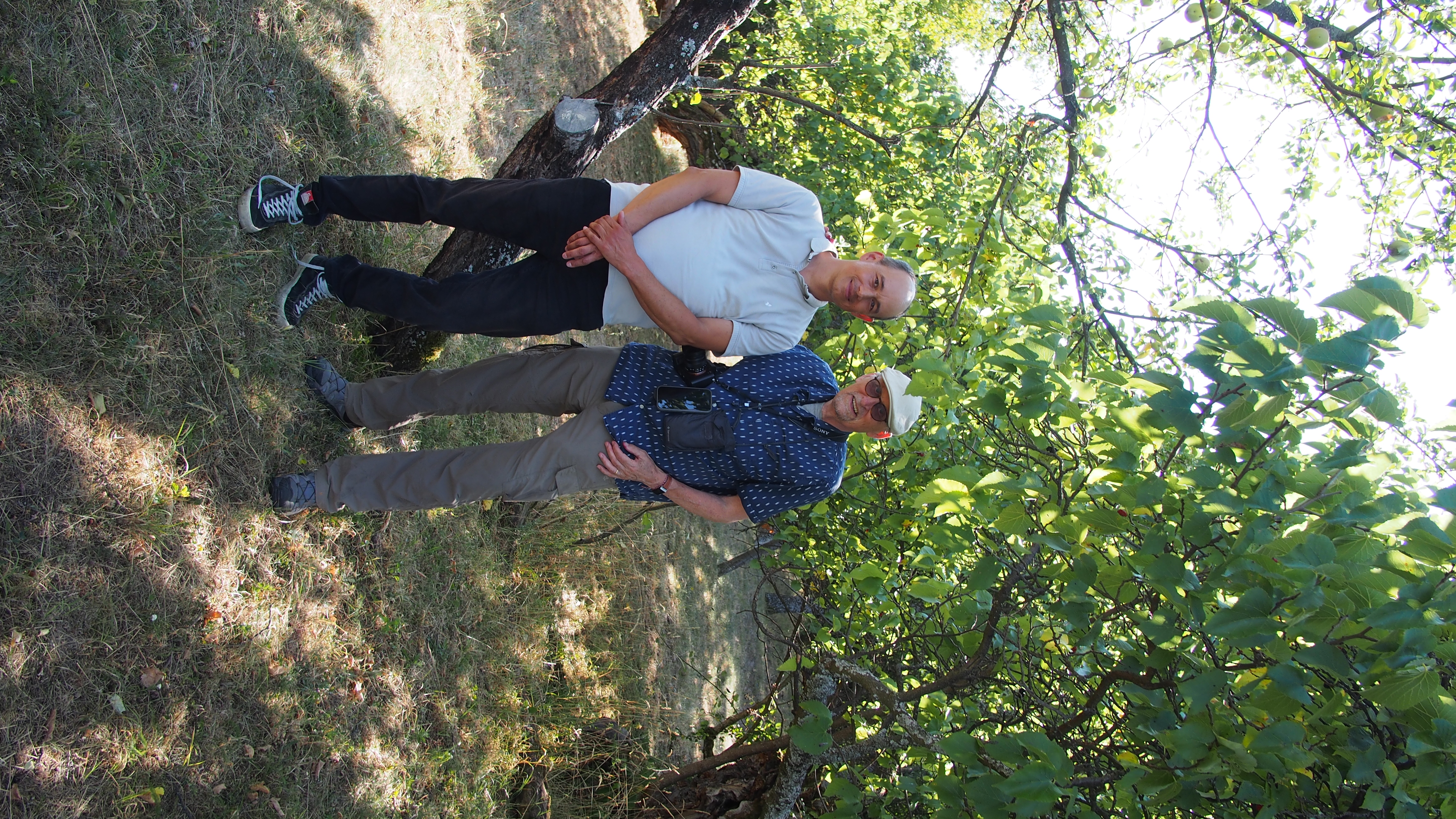
Miloslav Bahna (left) with Peter Coles
“There have been at least three generations of cataloguing the trees,” he explains. “The earliest was done sometime between 1979 – 80 by Ján Králik and Ján Rosenberger who later filed the proposal to establish black mulberries as a protected natural monument in 1988. Later, a local biology student Branislav Mikuška counted the trees as part of his MA thesis in 2002. Some of his markings on the trees with numbers were still on the trees when I mapped them in the last 10 years.
The latest and probably the most professional cataloguing of the tree was made by a team from Slovak University of Agriculture in Nitra, led by Ján Brindza. They identified 470 trees in Pukanec, 115 trees in the neighbouring Devicany and a further 260 in other neighbouring villages. Their mapping covered the whole of Slovakia where they identified altogether 964 trees. They published the results in international academic outlets and this is probably the only English language mention of the Pukanec mulberries in academic literature so far.
“As of today, I have mapped and photographed 445 trees in Pukanec, and another 154 all over Slovakia, but mostly in the immediate surroundings of Pukanec. There are definitely a few more trees to find in Pukanec”.
Mulberry trail
In 1988 the Pukanec black mulberry was designated as a nationally protected natural feature – a designation which sadly no longer exists. In 2018, in an effort to raise awareness and protect the regions ancient trees, the first black mulberry festival was held in Pukanec, in conjunction with the Tekov-Hont Civic Association and a 3 km educational trail created, winding through the hillsides around Pukanec, with information panels at strategic waypoints.
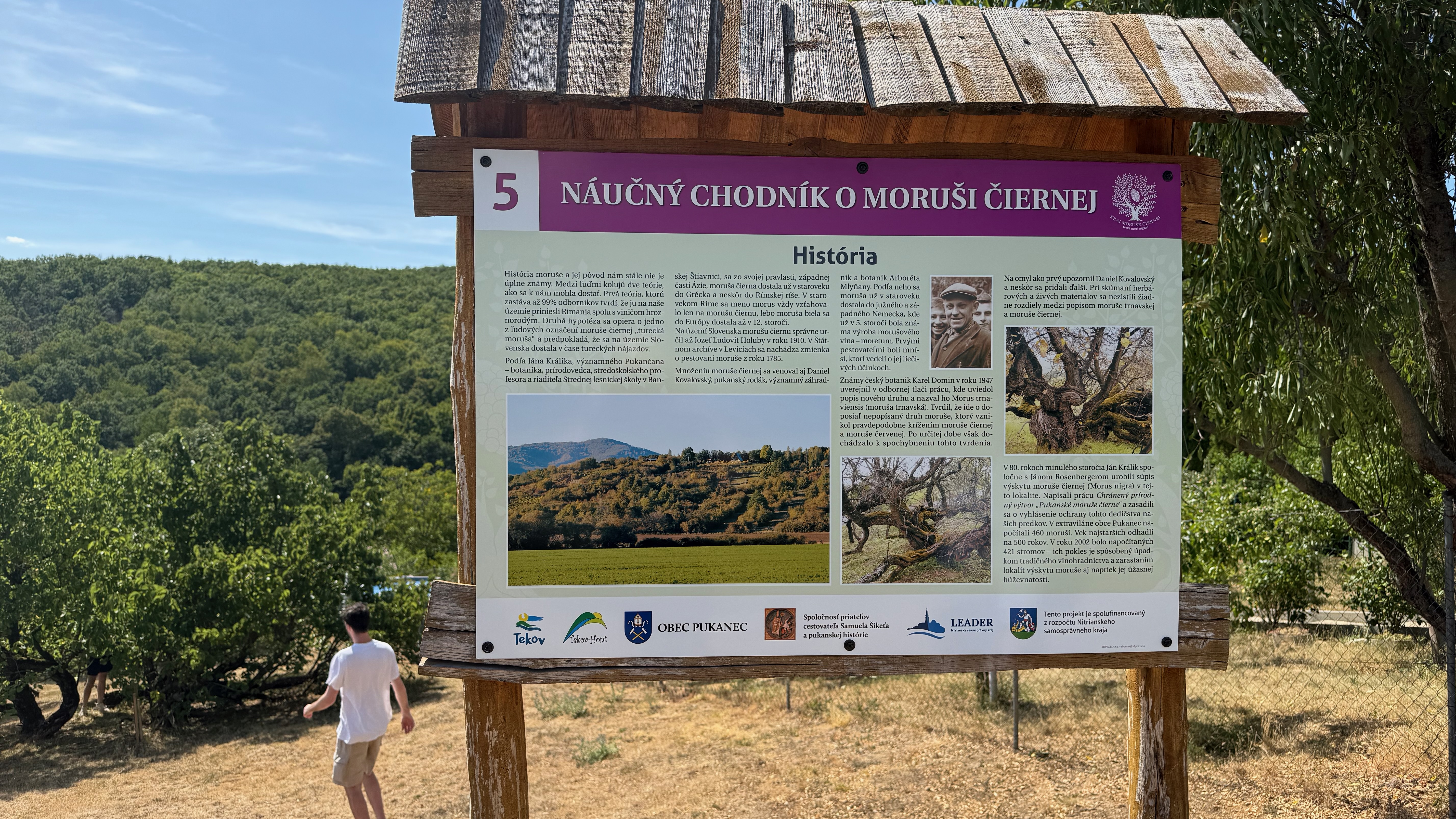
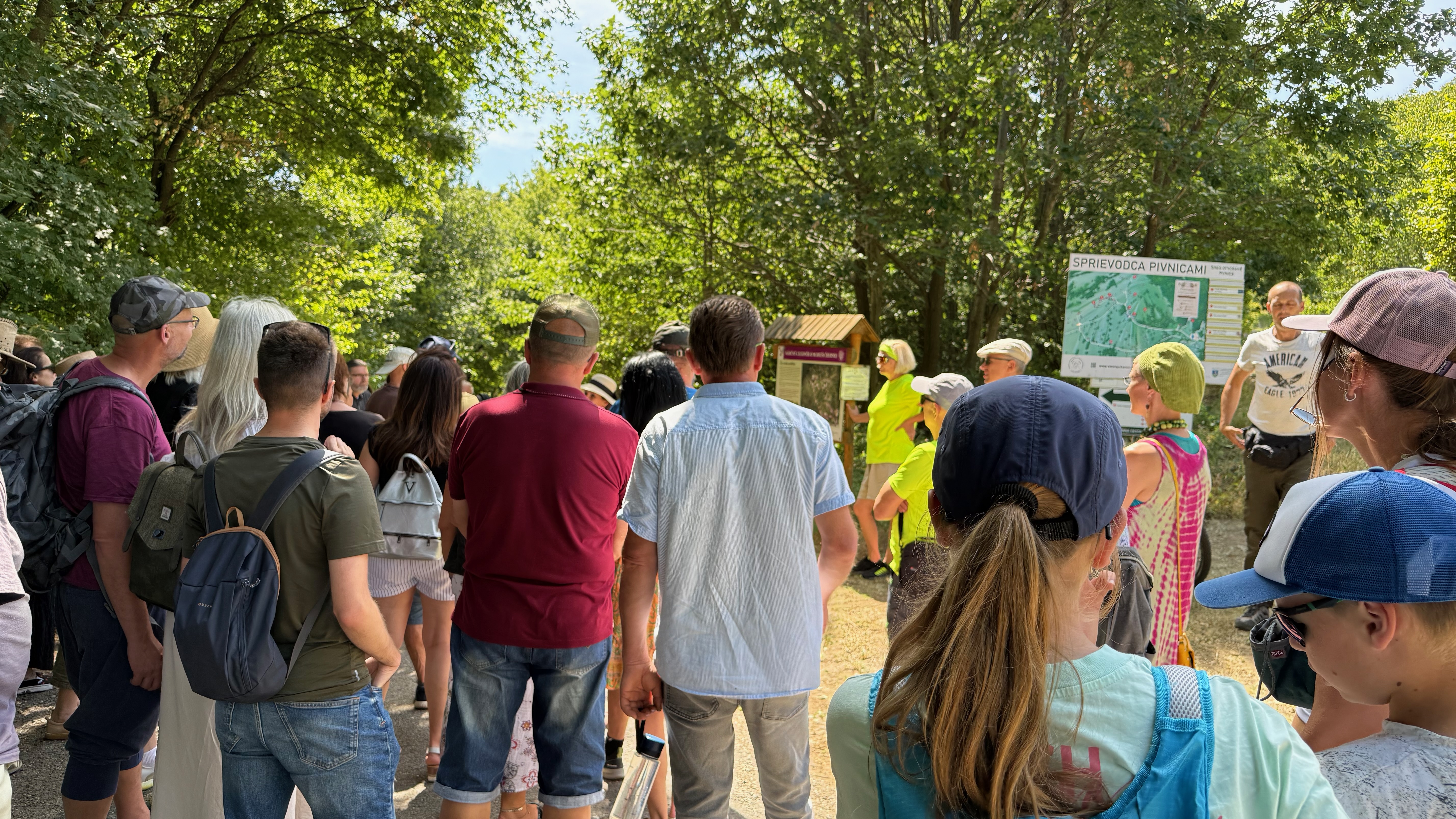
The trail passes by some extraordinary historic trees, whose age is not known for certain, but in several cases could be more than 400 years.
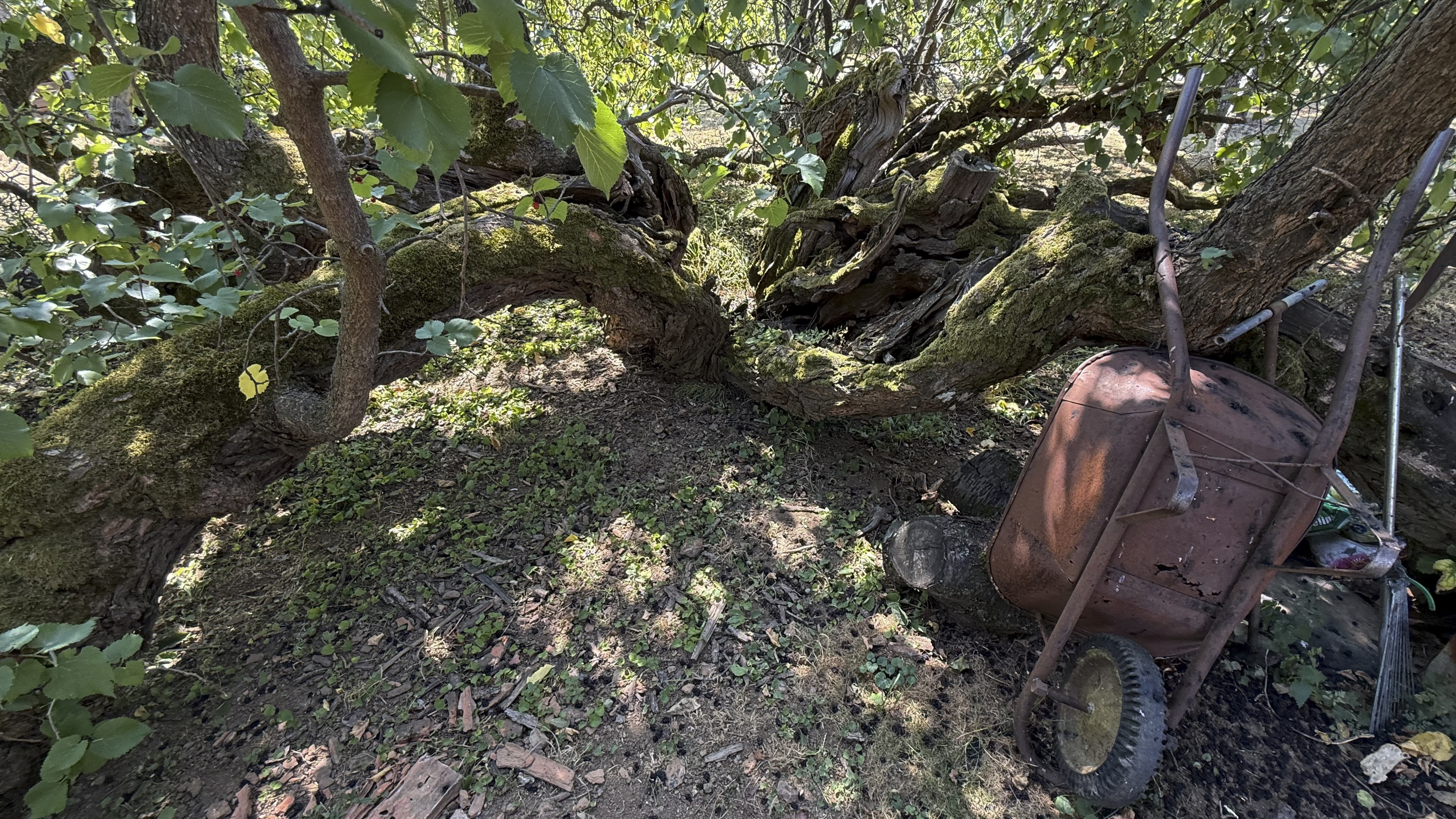
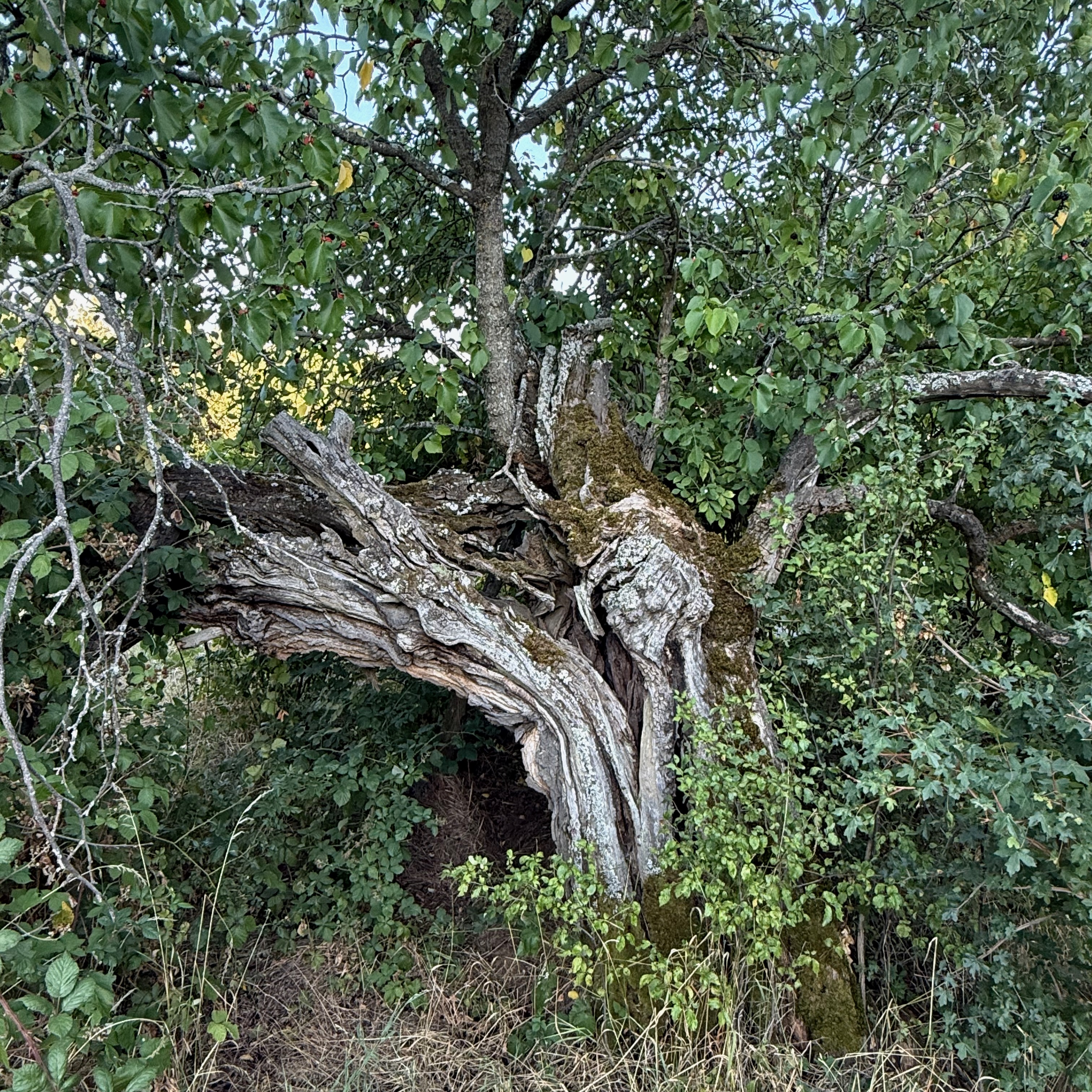
A mini Morus collection
In the heart of Pukanec is the home of Stanislav Stroška, another local mulberry expert, who is passionate about the species. Stanislav, whose brand of mulberry produce is marketed as Stanley, is a keen collector and propagator of cultivars and species of white mulberry. In fact, his collection, which currently stands at 54 species and cultivars, is more numerous that the UK’s National Morus collection held at Buckingham Palace, which has 45 named taxa. Stanislav’s collection even features the rare Ogasawa mulberry, Morus boninensis, which is only found on a few remote islands off the coast of Japan and rare collections in Europe.
Incidentally, there is no meaning to having a national collection of black mulberries (Morus nigra), as the species is genetically complex (with 308 chromosomes in multiple duplicates) and does not hybridise. This means there are no cultivars, just named lineages with small variations such as the size and shape of fruit and leaves.
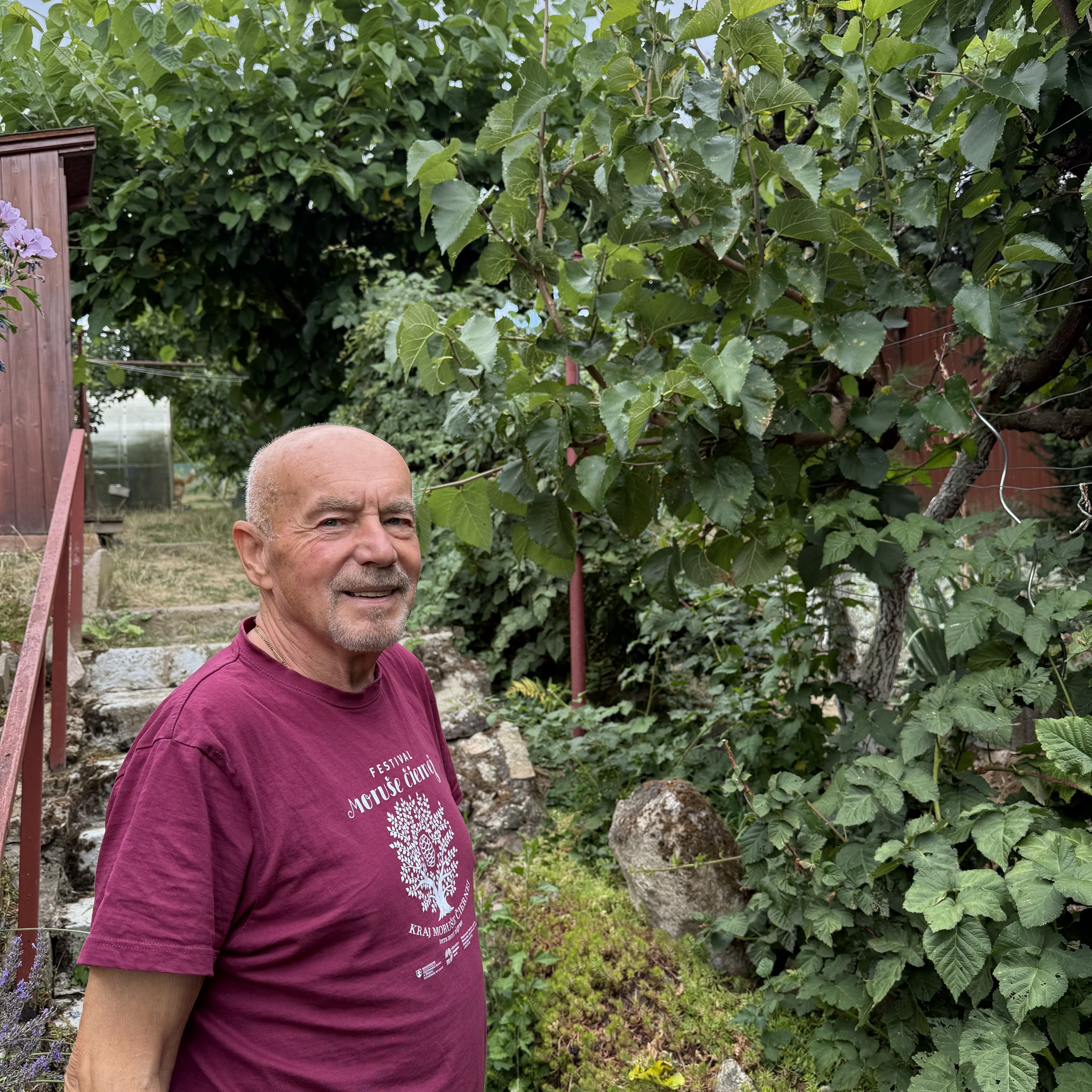
Stanislav Stroška with his mulberry collection
How old are they?
Some of the veteran mulberry trees I was able to see with Miloslav are clearly centuries old – perhaps even 500 years of age. The original bole may have rotted away, leaving a grove of phoenix trees covering a wide area. In appearance, they are older than the oldest black mulberries I have seen in Britain, at Syon House, where accounts exist showing purchase in 1604, or at Groton Winthrop (Suffolk) with claims to be 16th century.
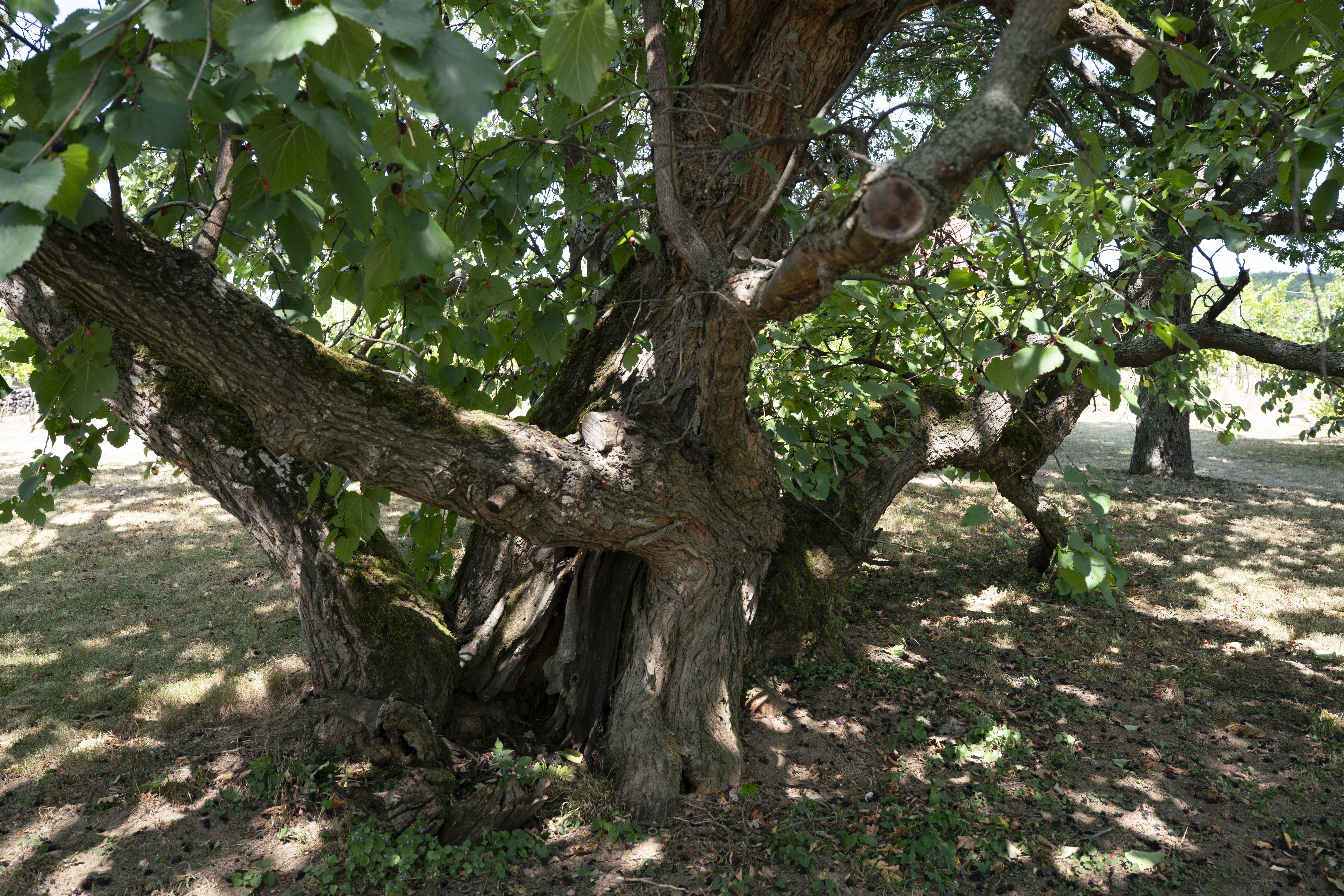
Discovering how and when these trees came to Pukanec has puzzled Slovak researchers for some time. As Miloslav Bahna summarises:
In Pukanec, the locals will tell you about three possible origins of the trees – the Romans, the monks in the Middle Ages and the Turks. Even though Pukanec was in the Ottoman – Habsburg borderland for 150 years and there has been exchange (and plundering as well) with the Turks, archaeological finds identify black mulberry trees in Slovakia already in the early Middle Ages. So most likely Pukanec did not need to wait for the Turks to bring the tree.
Basically, then, nobody knows. The absence of heart wood in old trunks and stumps rules out counting rings to establish age. Meanwhile, the tendency of old trees to split and collapse makes traditional girth measurement meaningless. Carbon-14 dating is not effective for old trees, but advances in dendrochronology are nevertheless promising, where ring-patterns in different trees are matched to estimate age.
Appeal for greater protection
Pukanec is only just gaining recognition for its unique population of ancient black mulberry trees. They now have no meaningful national protection, while their cultural and commercial value is, as yet, barely exploited. With the black mulberry’s proven resilience to climate change and its pharmacological benefits – as an antioxidant and the capacity to lower blood sugar levels, for example – Pukanec has everything to play for in terms of preserving and developing its unique resource.
In a booklet entitled Metamorfózy Moruše, published this year by the organizers of the festival, Ludovit Vašš appeals for greater protection for and local awareness of Pukanec’s unique black mulberry heritage.
Quoting from his chapter in the book (AI translation from Slovak):
“In the context of ongoing climate change, where the black mulberry, once mature, withstands drought and summer heat exceptionally well, its importance to our country is literally irreplaceable. Paradoxically, today it is most threatened by humans themselves – through the reckless destruction of historic localities and the massive spread of fungal pathogens via open wounds caused by unprofessional, devastating chainsaw cuts.
Systematic support for the conservation of this species in Slovakia is currently completely lacking:
- Although the black mulberry was declared a protected natural species in 1988, in practice there is a complete lack of state funding for the care of dying, ageing trees or the targeted planting of new ones.
- There is no central state gene bank orchard which would guarantee systematic conservation and pure propagation.
- Specialist knowledge is often confined solely to academic publications, with no accessible popular science literature available.
- Today, such initiatives are taken up exclusively by enthusiasts and fruit growers.”